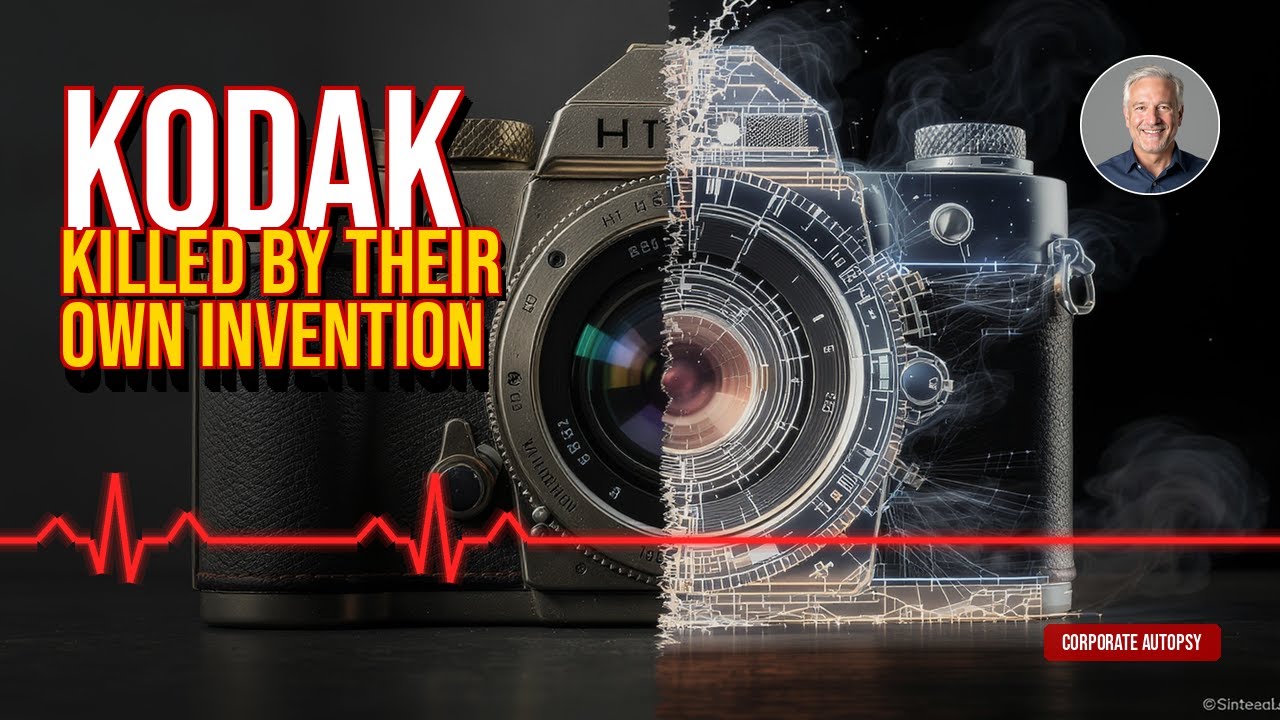
The Kodak Paradox: How the Company That Invented Digital Photography Became Its Victim
In the annals of corporate history, few stories capture the brutal irony of technological disruption quite like Kodak’s rise and fall. The company that dominated photography for over a century didn’t just witness the digital revolution—they invented it. Then, in a decision that would ultimately destroy them, they chose to bury their own creation.
The Secret Birth of Digital Photography
December 1975. While America was still processing the end of the Vietnam War and the beginning of the personal computer age, a 24-year-old Kodak engineer named Steve Sasson was quietly making history in a Rochester, New York laboratory. Working with a charge-coupled device (CCD) from Fairchild Semiconductor, Sasson had assembled what would become the world’s first digital camera.
The contraption was hardly elegant—roughly the size of a toaster, weighing 8 pounds, and capable of capturing black-and-white images at a resolution of 0.01 megapixels. Each photograph took 23 seconds to record onto a digital cassette tape and another 23 seconds to display on a television screen. But for all its limitations, Sasson’s invention represented a seismic shift in how images could be captured, stored, and shared.
When Sasson demonstrated his digital camera to Kodak executives, their response was swift and decisive: keep it quiet. The reasoning was coldly logical from a short-term business perspective. Kodak controlled approximately 90% of film sales in the United States and commanded 85% of camera sales. Why would they want to promote a technology that could eliminate the need for film—the source of their massive profit margins?
The Film Empire That Couldn’t Adapt
To understand Kodak’s fatal miscalculation, one must first appreciate the sheer dominance they had built since George Eastman founded the company in 1888. Eastman’s revolutionary “You press the button, we do the rest” philosophy had democratized photography, transforming it from a specialist’s pursuit into a mass-market phenomenon.
By the 1970s, Kodak’s business model was a masterclass in recurring revenue. They sold cameras at modest profits, then generated enormous margins on film and processing services. Every vacation snapshot, wedding photo, and family portrait required Kodak film. Every roll needed Kodak chemicals for development. It was, quite literally, a money-printing operation.
The numbers were staggering. In 1976, the year after Sasson’s digital breakthrough, Kodak employed 62,000 people in Rochester alone. The company’s annual revenue exceeded $5 billion, with profit margins that made Wall Street analysts swoon. Film wasn’t just Kodak’s product—it was their identity, their culture, and their future as they saw it.
The Sterling Drug Distraction
While Kodak executives were busy suppressing digital photography, they made another decision that would prove equally disastrous. In 1988, CEO Colby Chandler orchestrated the acquisition of Sterling Drug for $5.1 billion, betting that Kodak could successfully diversify into pharmaceuticals.
The Sterling acquisition revealed the depth of Kodak’s strategic confusion. Here was a company sitting on revolutionary imaging technology, yet choosing to chase opportunities in an entirely unrelated industry. The pharmaceutical venture consumed management attention and financial resources that might have been better invested in digital imaging research and development.
The Sterling experiment was a comprehensive failure. Kodak lacked the regulatory expertise, distribution networks, and cultural DNA necessary to compete in pharmaceuticals. By 1994, they had divested most of their drug operations, writing off billions in losses. Those six years of distraction coincided with crucial developments in digital imaging technology—developments that were happening at companies like Canon, Sony, and eventually, Apple.
The Crossover Point: When Digital Overtook Film
For nearly two decades after Sasson’s invention, Kodak’s strategy of digital suppression appeared to be working. Film sales continued growing through the 1980s and 1990s, buoyed by expanding global markets and the popularity of disposable cameras. Even as digital cameras began appearing in consumer electronics stores in the late 1990s, their high prices and poor image quality seemed to validate Kodak’s cautious approach.
But technological progress follows exponential curves, not linear ones. The crucial tipping point came in 2003, when global digital camera sales surpassed film camera sales for the first time. Suddenly, the world was transitioning to filmless photography faster than even the most aggressive predictions had suggested.
Kodak found themselves in the uncomfortable position of playing catch-up in a market they had essentially invented. Their digital cameras were competent but unremarkable, lacking the innovation edge that had once defined the company. Worse, the digital photography market operated on fundamentally different economics than film photography. Cameras needed to generate profits upfront, rather than through ongoing film sales.
The Smartphone Revolution: The Final Blow
Just as Kodak was beginning to find its footing in digital cameras, another disruption emerged that would prove even more devastating: smartphone photography. The introduction of the iPhone in 2007, followed by Android devices with increasingly sophisticated cameras, democratized photography in ways that even George Eastman couldn’t have imagined.
Smartphones eliminated the need for standalone cameras for most consumers. Why carry a separate device when your phone could capture, edit, and instantly share photographs? The convenience factor was overwhelming, and the image quality gap closed rapidly as smartphone cameras improved.
By 2010, smartphone cameras were capturing more photographs than all dedicated cameras combined. Apps like Instagram, launched that same year, created new photography cultures that had nothing to do with printing physical images. The entire ecosystem that had supported Kodak’s business model for over a century was disappearing.
Antonio Perez and the Failed Transformation
In 2005, Kodak hired Antonio Perez as CEO, tasking him with leading the company’s digital transformation. Perez, a former Hewlett-Packard executive, understood the urgency of the situation and attempted to pivot Kodak toward digital printing and imaging services.
Under Perez’s leadership, Kodak invested heavily in digital printing technology, hoping to replicate their film-era success in the digital realm. They developed innovative products like the EasyShare printer dock and pursued partnerships with retail chains to install Kodak photo kiosks.
But the transformation came too late and moved too slowly. The company was still generating substantial revenue from film sales, particularly in emerging markets, which created internal resistance to more aggressive digital strategies. Kodak found itself caught between two worlds—unable to fully commit to digital innovation while their traditional business steadily declined.
The Bankruptcy and Beyond
On January 19, 2012, Kodak filed for Chapter 11 bankruptcy protection, ending 131 years as an independent company. The filing was both shocking and inevitable—shocking because of Kodak’s iconic status in American business, inevitable because their digital transition had failed so completely.
The bankruptcy proceedings revealed the full extent of Kodak’s patent portfolio related to digital imaging. Ironically, the company that had suppressed digital photography held some of the most valuable intellectual property in the field. They eventually sold these patents for $525 million, providing some compensation for creditors but highlighting the tragic waste of their technological leadership.
Lessons for the Modern Era
The Kodak story offers profound insights into the nature of technological disruption and corporate innovation. Their failure wasn’t due to lack of technical capability—they literally invented the technology that replaced them. Instead, they fell victim to what business theorists call “incumbent blindness”: the inability to see beyond the constraints of existing business models.
This pattern repeats constantly in modern technology markets. Established companies with profitable legacy businesses struggle to cannibalize their own success, even when they possess superior technology and resources. The incentive structures, cultural norms, and financial pressures that drive success in mature markets often become liabilities when disruptive change arrives.
Today’s technology giants face similar challenges. Will Netflix successfully transition from streaming to interactive entertainment? Can traditional automakers compete with Tesla in electric vehicles? Will Microsoft maintain its dominance as computing shifts toward artificial intelligence and cloud services?
The Kodak case study suggests that technological superiority and market leadership provide no guarantees of survival when fundamental industry shifts occur. Companies must be willing to destroy their own business models before competitors do it for them—a level of corporate courage that proves extraordinarily rare in practice.
Steve Sasson’s digital camera may have been crude by today’s standards, but it represented something more valuable than any individual product: the future of an entire industry. Kodak’s decision to suppress that future in favor of protecting past profits stands as one of the most instructive failures in business history, a reminder that in times of technological change, the greatest risk often lies in playing it safe.