The PG&E Scandals: From Hinkley’s Poisoned Water to Paradise’s Deadly Flames
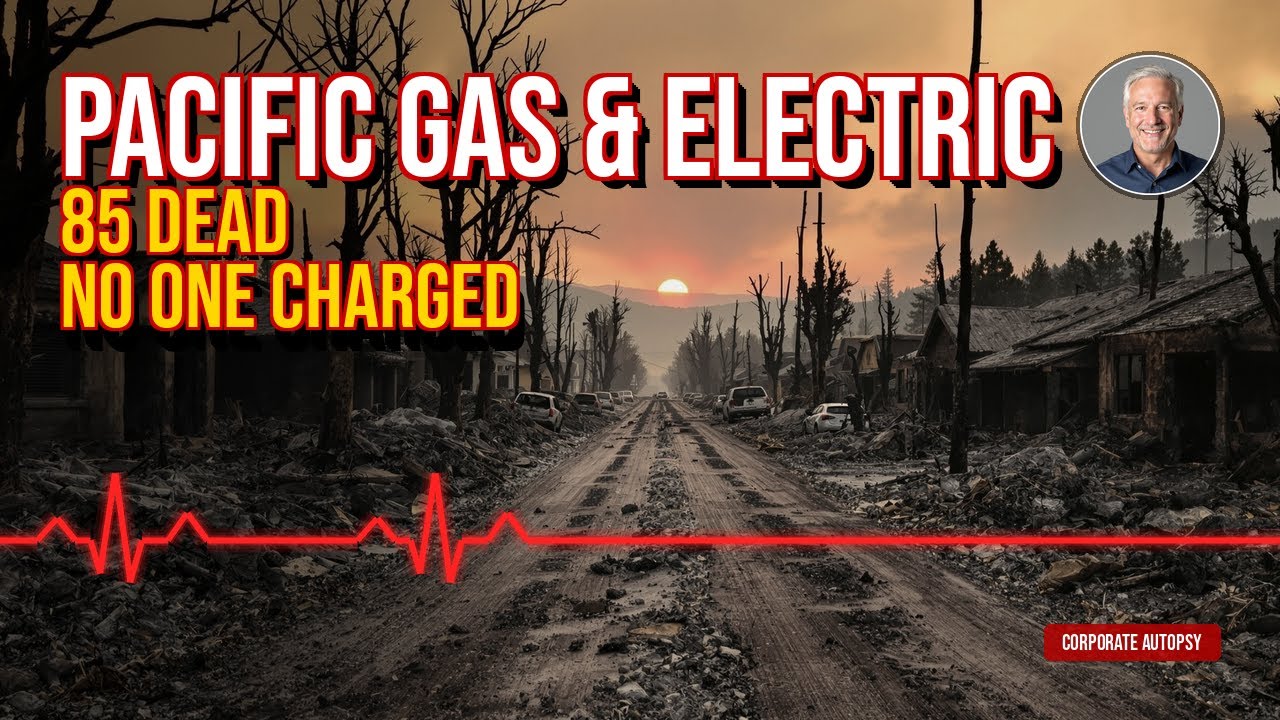
When Pacific Gas & Electric Company pleaded guilty to 84 counts of involuntary manslaughter in June 2020, it marked an unprecedented moment in corporate criminal history. Yet for all the legal firsts, the most striking aspect remained what didn’t happen: not a single executive faced criminal charges for deaths that prosecutors called entirely preventable.
This extraordinary case of corporate accountability—or the lack thereof—spans more than a century of environmental disasters, regulatory failures, and human tragedy. From the chromium-poisoned groundwater of Hinkley, California, made famous by Erin Brockovich’s investigation, to the Camp Fire that incinerated Paradise in 2018, PG&E’s pattern of negligence reveals how America’s largest utility monopoly operates with virtual impunity.
The Hinkley Contamination: Decades of Deliberate Deception
Between 1952 and 1966, Pacific Gas & Electric’s Hinkley Compressor Station dumped an estimated 370 million gallons of hexavalent chromium-contaminated wastewater into unlined ponds. The toxic waste seeped into the groundwater that supplied drinking water to the 650 residents of this small Mojave Desert community.
Hexavalent chromium, also known as chromium-6, is a known human carcinogen that causes lung cancer when inhaled and has been linked to stomach cancer, reproductive problems, and developmental issues in children. PG&E had been using the chemical as a rust inhibitor in their cooling towers, fully aware of its toxicity.
The contamination wasn’t an accident—internal company documents later revealed that PG&E knew about the groundwater pollution as early as 1965. Rather than alert residents or regulators, the company chose concealment. They even went so far as to tell Hinkley residents that the chromium in their water was actually beneficial to their health, a claim so audacious it defies belief.
By the 1980s, residents began noticing unusual health problems: clusters of cancer, miscarriages, and birth defects that seemed far too common for such a small community. Roberta Walker, a local real estate agent, started connecting the dots when she noticed that homes near the compressor station were particularly hard to sell, often due to serious illnesses affecting the families living there.
Enter Erin Brockovich: The Legal Secretary Who Took Down a Giant
In 1991, legal secretary Erin Brockovich began investigating unusual real estate files cross-referenced with medical records while working at the law firm Masry & Vititoe. Her persistence and direct approach with Hinkley residents uncovered what would become the largest settlement in a direct-action lawsuit in U.S. history.
Brockovich’s investigation revealed that PG&E had systematically covered up the contamination for decades. The company had been monitoring the groundwater and knew the exact extent of the pollution, yet continued to assure residents their water was safe. Internal memos showed company officials discussing how to minimize their legal exposure while doing as little as possible to address the contamination.
The lawsuit, filed in 1993, ultimately encompassed 634 Hinkley residents. In 1996, PG&E agreed to pay $333 million in damages—approximately $525,000 per plaintiff. While substantial, the settlement came with no admission of wrongdoing, allowing PG&E to maintain its public stance that the contamination posed no health risks.
The Pattern Emerges: San Bruno and Corporate Negligence
The Hinkley settlement should have marked a turning point for PG&E’s safety culture. Instead, it became clear that the company’s problems extended far beyond a single contaminated site. On September 9, 2010, a PG&E natural gas pipeline exploded in the San Bruno neighborhood of Crestmoor, killing eight people and destroying 38 homes.
The cause was a 30-inch steel pipeline installed in 1956 that PG&E had incorrectly classified in their records. The company claimed it was a seamless pipe when it was actually a welded pipe with a defective seam. For decades, PG&E’s records contained this critical error, leading to inadequate pressure testing and maintenance.
Federal investigators found that PG&E had repeatedly ignored warning signs of pipeline problems throughout their system. The company had been operating on outdated maps, some hand-drawn, and had failed to conduct proper inspections despite knowing their record-keeping was unreliable.
Bill Johnson, who became PG&E’s CEO in 2019, would later acknowledge that the utility had prioritized profits over safety for decades. “We were managing this company for financial performance,” Johnson admitted in congressional testimony, “and not managing it as a public safety company.”
Paradise Lost: The Camp Fire Catastrophe
The deadly culmination of PG&E’s negligent practices came on November 8, 2018, when a nearly century-old transmission line failed in the hills above Paradise, California. The Caribou-Palermo transmission line, installed in 1921, had been scheduled for replacement but remained in service far beyond its intended lifespan.
At approximately 6:15 AM, a worn suspension hook broke, causing a live wire to fall and strike nearby vegetation. The resulting sparks ignited what would become the deadliest wildfire in California history. Within hours, the entire town of Paradise—population 26,800—was engulfed in flames.
The speed and ferocity of the Camp Fire was unprecedented. Driven by hot, dry Diablo winds gusting up to 50 mph, the fire advanced at a rate of one football field per second. Residents had minutes, not hours, to evacuate. Many never made it out.
Eighty-five people died in the Camp Fire, ranging in age from 20 to 99. The victims included families trapped in cars during the chaotic evacuation, elderly residents who couldn’t escape their homes, and people who stayed behind to protect their property. The fire destroyed 18,804 structures and burned 153,336 acres before full containment on November 25.
The Legal Reckoning: Unprecedented Charges, Familiar Outcomes
In 2020, Butte County District Attorney Mike Ramsey filed criminal charges against PG&E for the Camp Fire deaths—84 counts of involuntary manslaughter (one victim died from causes unrelated to the fire) and one count of unlawfully causing a fire. The charges marked the first time a major corporation had been prosecuted for homicide in connection with a wildfire.
The evidence against PG&E was overwhelming. California Department of Forestry and Fire Protection investigators found that the utility’s equipment had “caused” the fire and that the company’s vegetation management around the transmission line was inadequate. PG&E had been aware of problems with the specific hook that failed but had not scheduled it for replacement.
On June 16, 2020, PG&E pleaded guilty to all charges. The company agreed to pay the maximum fine of $3.5 million, plus $500,000 in investigation costs. For a corporation with annual revenues of $17 billion, the penalty amounted to roughly two hours of revenue.
Geisha Williams, who served as PG&E’s CEO from 2017 to 2019, oversaw the company during the period when many of the safety failures occurred. She resigned in January 2019 as the full scope of the Camp Fire liability became clear, receiving a severance package worth millions despite the company’s role in the tragedy.
The Accountability Gap: Why No Executives Faced Charges
Perhaps the most troubling aspect of the PG&E prosecutions is what didn’t happen. Despite clear evidence of corporate negligence spanning decades, not a single executive or manager has ever faced personal criminal charges in connection with the Hinkley contamination, San Bruno explosion, or Camp Fire deaths.
Legal experts point to the difficulty of proving individual criminal intent in complex corporate structures. Prosecutors must show that specific executives knew about specific dangers and deliberately chose to ignore them. Corporate decision-making is often diffused across multiple departments and management levels, making it challenging to establish direct culpability.
However, critics argue that this legal standard effectively immunizes corporate executives from the consequences of their companies’ deadly actions. When corporations can simply pay fines—often passed on to ratepayers—while individual decision-makers face no personal consequences, the incentive structure for safety improvements remains fundamentally flawed.
Regulatory Capture and the Utility Monopoly Problem
PG&E’s ability to continue operating despite its deadly track record highlights broader problems with utility regulation in California. As the state’s largest investor-owned utility, PG&E serves 16 million customers across Northern and Central California. The company’s monopoly status means customers have no choice but to purchase electricity and natural gas from PG&E, regardless of its safety record.
The California Public Utilities Commission (CPUC), the agency responsible for regulating PG&E, has been criticized for maintaining too cozy a relationship with the utility it’s supposed to oversee. Former CPUC commissioners and staff regularly move to jobs with utilities, while utility executives often join the commission—a pattern known as “regulatory capture.”
This revolving door has contributed to a regulatory environment where utilities’ financial interests often take precedence over public safety. Rate-setting procedures focus heavily on ensuring utilities can earn adequate returns for investors, with safety considerations receiving less systematic attention.
The Human Cost of Corporate Immunity
Behind the legal proceedings and regulatory failures are real people whose lives were destroyed by PG&E’s negligence. In Hinkley, residents like Roberta Walker watched their community literally disappear as families moved away to escape the contaminated groundwater. Many residents developed cancers and other health problems they attribute to decades of chromium exposure.
Paradise resident Dorothy Mack, 93, was found dead in her home after the Camp Fire. She had lived independently until the fire and had planned to evacuate, but the flames moved too quickly. Her death, like 83 others, was ruled preventable by investigators who found that earlier vegetation management and equipment maintenance could have prevented the fire entirely.
The psychological trauma extends beyond the immediate victims. Paradise survivors describe ongoing struggles with PTSD, anxiety, and depression. Many have never returned to rebuild, unable to face the possibility of experiencing another fire caused by utility negligence.
Modern Implications: What PG&E’s History Teaches Us
The PG&E case illuminates fundamental problems with how America holds corporations accountable for deadly negligence. While individual criminals face personal consequences for their actions, corporate decision-makers can cause far more deaths while facing only professional and financial repercussions.
This disparity becomes particularly problematic as corporate power continues to concentrate in fewer hands. When essential services like electricity and natural gas are controlled by monopolies, the lack of meaningful accountability creates a moral hazard that endangers public safety.
Climate change is making PG&E’s infrastructure problems more dangerous, not less. Rising temperatures, extended drought periods, and stronger winds all increase wildfire risk in areas served by aging utility equipment. Without fundamental changes to corporate accountability, California faces the prospect of more fires, more deaths, and more corporate guilty pleas followed by business as usual.
The question raised by District Attorney Ramsey during the Camp Fire prosecution remains unanswered: “Can you hold a corporation accountable for killing people without holding the people who run it accountable?” Until that accountability gap is closed, the pattern of corporate negligence, public tragedy, and legal impunity seems destined to continue.