The Rise and Fall of Sears: How America’s First Retail Giant Became a Cautionary Tale
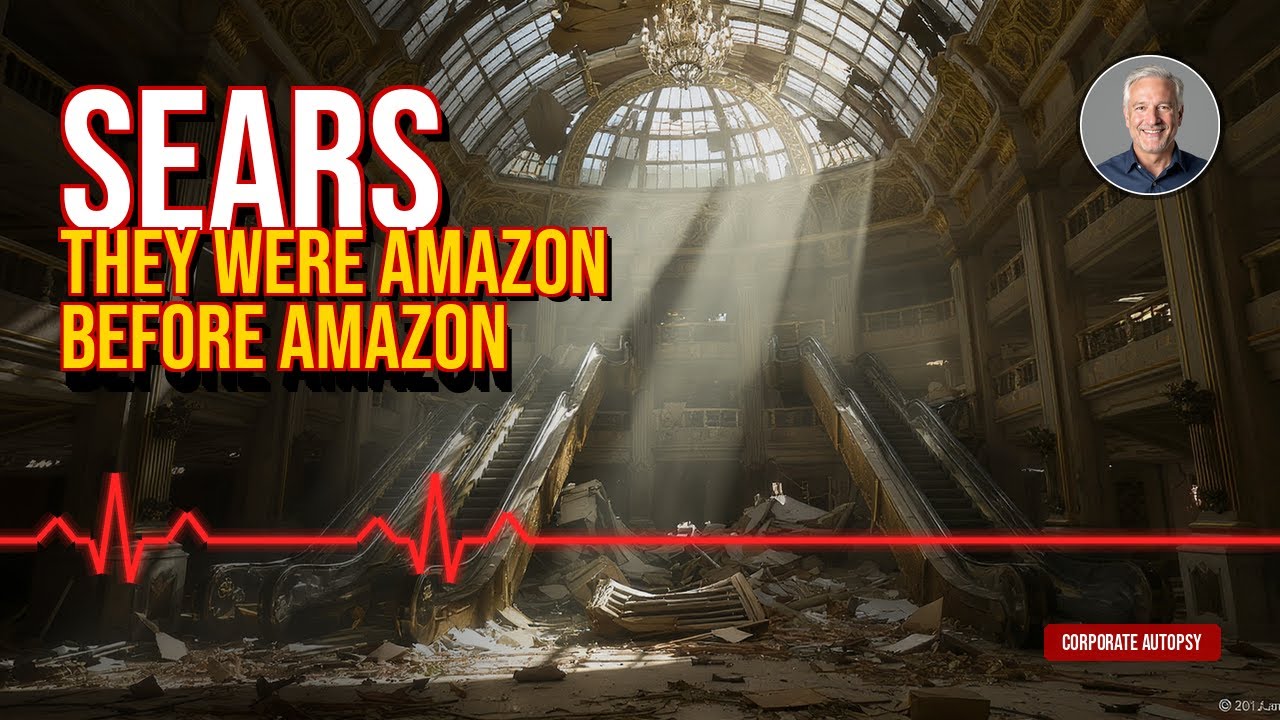
In the pantheon of American business disasters, few collapses are as shocking as Sears, Roebuck and Company. Once the undisputed king of American retail—commanding $50 billion in annual revenue at its peak—Sears filed for bankruptcy protection in October 2018, ending a 126-year run as one of the nation’s most recognizable brands. The company that literally wrote the book on catalog retail, revolutionized department store shopping, and helped build suburban America had been reduced to a shadow of its former self, operating fewer than 700 stores compared to its peak of over 3,500 locations.
But this wasn’t a sudden death. Sears died by a thousand cuts, each more preventable than the last. While many point to the rise of e-commerce and Amazon as the primary culprit, the real story is far more complex—and damning. Under the leadership of hedge fund manager Eddie Lampert, Sears became a case study in how financial engineering and ideological management theories can destroy even the most established American institution.
The Catalog Kings: How Sears Built an Empire
To understand the magnitude of Sears’s fall, you must first grasp the heights from which it tumbled. Founded in 1892 by Richard Warren Sears, a railway station agent who started selling watches, the company initially found success through an innovative business model: mail-order catalogs. When Julius Rosenwald joined as a partner in 1895, bringing both capital and operational expertise, Sears transformed from a small watch company into America’s first truly national retailer.
The Sears catalog became known as “America’s Wishbook,” a thick tome that arrived in rural households across the country twice a year. By 1908, Sears was generating $40 million in annual revenue—roughly $1.4 billion in today’s dollars. The catalog contained everything from clothing and tools to entire houses (yes, Sears sold over 70,000 kit homes between 1908 and 1940). For millions of Americans, particularly those in rural areas underserved by traditional retailers, Sears was their primary connection to modern consumer goods.
The genius of the early Sears model lay in its understanding of American geography and demographics. While competitors focused on urban markets, Sears built a business around serving everyone else. They invested heavily in logistics, establishing massive distribution centers and leveraging the expanding railroad network to reach customers nationwide. By 1925, Sears had become the largest retailer in the world.
Retail Revolution: The Suburban Expansion
As America suburbanized after World War II, Sears proved it could evolve. The company pioneered the concept of anchor stores in shopping malls, using its brand recognition to draw customers to new suburban retail centers. Between 1950 and 1980, Sears opened hundreds of department stores, each designed as a one-stop destination for middle-class families.
During this golden era, Sears didn’t just sell products—it shaped American consumer culture. The company developed and promoted its own brands, from Craftsman tools to Kenmore appliances to DieHard batteries. These private labels offered quality comparable to national brands at lower prices, creating customer loyalty that lasted generations. Sears became so synonymous with American retail that by 1970, one in five Americans shopped there regularly.
The numbers from Sears’s peak years are staggering. In 1973, the company completed the Sears Tower (now Willis Tower) in Chicago, which stood as the world’s tallest building until 1998. At its retail peak in the 1980s, Sears operated over 3,500 stores and employed more than 350,000 people. The company’s revenues exceeded those of many small countries.
The Beginning of the End: Warning Signs in the 1990s
Even during its apparent success in the 1980s and early 1990s, cracks were beginning to show. Sears had become bureaucratic and slow to respond to changing consumer preferences. Competitors like Walmart were eating away at Sears’s price advantage, while specialty retailers like Home Depot and Best Buy were outflanking the department store model by offering deeper selection in specific categories.
The company’s response was telling: instead of focusing on retail innovation, Sears diversified into financial services, acquiring everything from real estate brokerages to investment firms. By the early 1990s, Sears was making more money from credit cards and insurance than from retail sales. This diversification strategy, while profitable in the short term, diverted attention and resources from the core retail business just as competition was intensifying.
Walmart’s rise was particularly devastating to Sears’s traditional customer base. Sam Walton’s company perfected the art of low-cost retail, using sophisticated logistics and aggressive vendor negotiations to offer brand-name merchandise at prices Sears couldn’t match. Between 1990 and 2000, Walmart’s revenue grew from $32 billion to $165 billion, while Sears struggled to maintain its $40 billion in annual sales.
Enter Eddie Lampert: The Hedge Fund Gamble
The most controversial chapter in Sears’s decline began in 2005, when hedge fund manager Eddie Lampert orchestrated a merger between Sears and Kmart, another struggling retailer. Lampert, who had made billions through strategic investments and financial engineering, believed he could apply Wall Street tactics to fix retail’s fundamental problems.
Lampert’s approach was rooted in libertarian economic theory and a belief that internal competition would drive efficiency. He restructured Sears into dozens of separate business units—hardware, appliances, clothing, automotive services—and forced them to compete against each other for resources. Instead of cooperation between departments, Lampert created a system where different parts of the company were essentially fighting each other for survival.
The results were catastrophic. Store managers stopped cooperating on promotions and inventory management. The appliance division began refusing to participate in store-wide sales because it hurt their individual profit metrics. Customer service deteriorated as departments prioritized their own financial targets over overall customer satisfaction. The very cooperation that had made Sears successful for over a century was systematically destroyed by Lampert’s management philosophy.
Asset Stripping and Financial Engineering
While Sears’s retail operations crumbled, Lampert embarked on an aggressive program of asset sales and financial engineering that many critics described as corporate cannibalization. The company sold off valuable real estate, spun off profitable divisions, and liquidated inventory to generate short-term cash flow. Between 2005 and 2018, Sears sold billions of dollars in assets, from the Craftsman tool brand to hundreds of prime retail locations.
Rather than reinvesting this money in store improvements, technology upgrades, or employee training, much of it flowed back to shareholders and executives. Lampert’s hedge fund, ESL Investments, collected hundreds of millions in dividends and fees while Sears stores grew increasingly shabby and understaffed. The company that once prided itself on customer service became notorious for long checkout lines, empty shelves, and demoralized employees.
Perhaps most damaging was Sears’s failure to invest in e-commerce during the critical period from 2005 to 2015. While Amazon was spending billions to build logistics networks and digital capabilities, Sears was cutting IT budgets and closing distribution centers. The company that had pioneered catalog shopping—essentially the first version of modern e-commerce—completely missed the digital revolution that followed.
The Amazon Comparison: What Could Have Been
The comparison between Sears and Amazon is particularly painful for anyone who understood retail history. Both companies started as catalog-based businesses focused on convenience and selection. Both built their early success on superior logistics and customer service. The key difference was timing and leadership philosophy.
Jeff Bezos explicitly modeled Amazon’s early strategy on Sears’s catalog business, but with crucial updates for the internet age. Where Sears had printed catalogs twice a year, Amazon could update its “catalog” instantly. Where Sears had relied on physical distribution centers, Amazon built a digital-first logistics network designed for individual shipments rather than bulk delivery to stores.
Most importantly, while Sears was cutting investment in its core business during the 2000s, Amazon was spending every available dollar on expansion and improvement. Bezos famously prioritized long-term growth over short-term profits, exactly the opposite of Lampert’s approach at Sears. The result: Amazon grew from a $7 billion company in 2005 to over $230 billion by 2018, the same period during which Sears collapsed from $50 billion to bankruptcy.
The Human Cost of Corporate Failure
Behind the financial metrics and strategic analysis lies a human tragedy that affected hundreds of thousands of workers and countless communities across America. Between 2010 and 2018, Sears closed over 2,800 stores, eliminating more than 250,000 jobs. These weren’t just statistics—they represented experienced retail workers, many of whom had spent decades with the company, suddenly finding themselves unemployed in an increasingly competitive job market.
The store closures were particularly devastating for smaller communities where Sears often served as an anchor tenant for local shopping centers. When Sears closed, it created a domino effect that frequently led to the closure of nearby businesses and the decline of entire commercial districts. In many American towns, the abandoned Sears store became a symbol of broader economic decline and the concentration of retail power in the hands of a few large corporations.
Current and former employees consistently reported that they could see the company’s decline in real-time: reduced staffing levels, deferred maintenance, empty stockrooms, and constant uncertainty about which locations would close next. Many described a sense of helplessness as they watched a company they had served faithfully for years make decisions that seemed designed to ensure its failure.
Lessons for Modern Business
The collapse of Sears offers crucial lessons for business leaders, investors, and policymakers. First, it demonstrates the danger of prioritizing financial engineering over operational excellence. While asset sales and cost-cutting can boost short-term financial metrics, they cannot substitute for genuine innovation and customer focus.
Second, the Sears story illustrates how quickly even dominant companies can lose their relevance when they fail to adapt to technological change. Sears had every advantage in the transition to e-commerce—brand recognition, logistics expertise, customer data, and catalog experience—but squandered these advantages through poor leadership and misaligned priorities.
Finally, Sears’s decline highlights the risks of extreme organizational fragmentation. While internal competition can drive efficiency in some contexts, Lampert’s approach destroyed the collaborative culture that had made Sears successful. Modern companies pursuing similar strategies should note how quickly cooperation can turn into destructive internal warfare when not carefully managed.
The Broader Pattern: American Retail’s Transformation
Sears’s collapse cannot be understood in isolation—it’s part of a broader transformation of American retail that has accelerated dramatically since 2000. Traditional department stores and general merchandise retailers have struggled to compete against both low-cost specialists like Walmart and convenient digital platforms like Amazon.
The COVID-19 pandemic further accelerated these trends, forcing even more consumers to embrace online shopping and delivery services. Companies that might have survived gradual change found themselves facing immediate existential threats as foot traffic disappeared and digital capabilities became essential rather than optional.
Yet some retailers have successfully navigated this transition by learning from Sears’s mistakes. Target reinvented itself through smart technology investments and store redesigns. Best Buy survived the “Amazon threat” by focusing on services and experiences that couldn’t be replicated online. Even Walmart, despite its size and legacy infrastructure, successfully built a competitive e-commerce platform.
The difference between these success stories and Sears’s failure often comes down to leadership philosophy and strategic priorities. Companies that invested in long-term capabilities rather than short-term financial optimization were better positioned to adapt when the retail environment shifted dramatically.
The story of Sears serves as both a historical case study and a contemporary warning. In an era when technological change can quickly render even dominant business models obsolete, the difference between adaptation and extinction often comes down to leadership choices made years or even decades earlier. For modern executives facing their own digital transformations, Sears’s rise and fall offers both inspiration about what’s possible and a sobering reminder of what’s at stake.