MKUltra: The CIA’s Hidden Mind Control Program That Experimented on Thousands of Americans
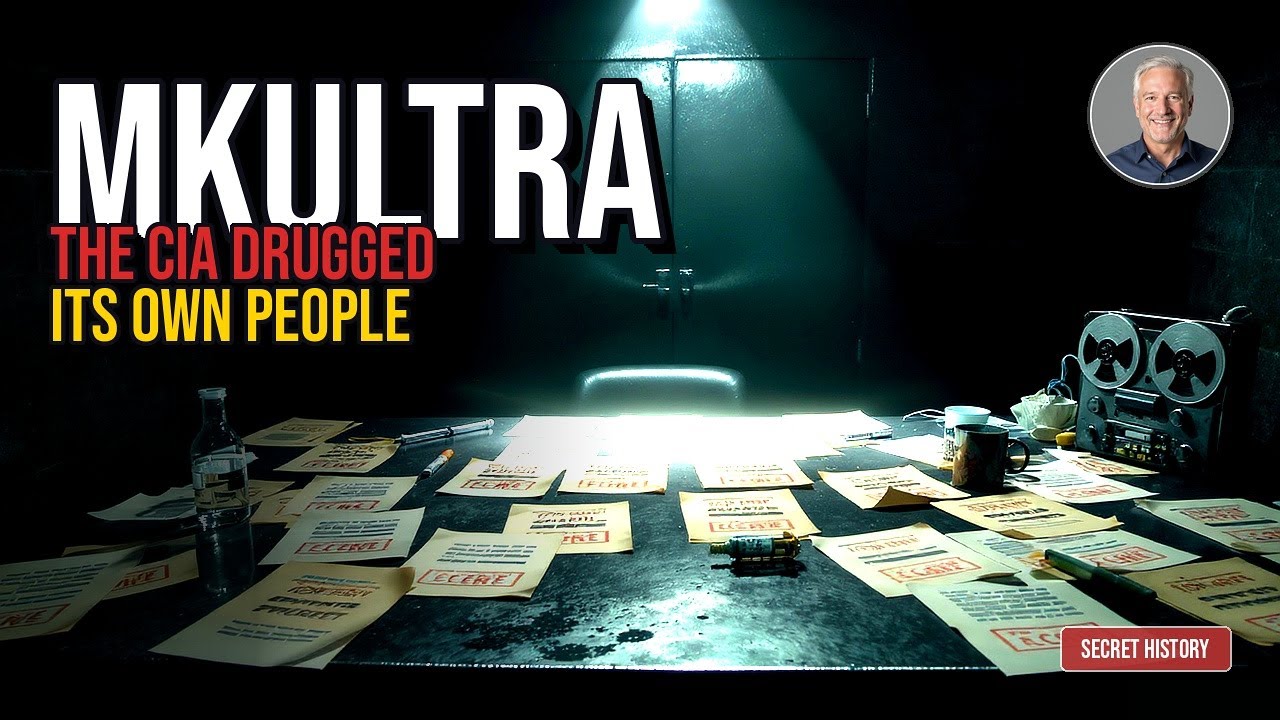
In 1977, a routine filing error at CIA headquarters would expose one of the most disturbing chapters in American intelligence history. Twenty thousand pages of documents that should have been destroyed seven years earlier suddenly surfaced, revealing the full scope of MKUltra—a covert program that subjected thousands of unwitting Americans to psychological experiments between 1953 and 1973.
What these rescued documents revealed was a systematic effort by the Central Intelligence Agency to develop methods of mind control, using everything from LSD to sensory deprivation, electroshock therapy to psychological torture. The program’s scope was staggering: 149 documented projects across 80 institutions, including universities, hospitals, and psychiatric facilities throughout the United States and Canada.
The Cold War Origins of Mind Control Research
The MKUltra program emerged from the paranoia and desperation of the early Cold War era. In 1950, American POWs returning from the Korean War told disturbing stories of “brainwashing” techniques used by Chinese and North Korean forces. These accounts, combined with the show trials of Cardinal József Mindszenty in Hungary and other apparent victims of Communist mind control, convinced CIA leadership that America was falling behind in a crucial new battlefield: the human mind.
Allen Dulles, who would become CIA Director in 1953, was particularly convinced that the Soviets had developed sophisticated methods of psychological manipulation. Speaking to Princeton alumni in 1953, Dulles warned that the Communists had developed techniques to “put a man’s mind into a fog so that he will mistake what is true for what is false.”
The CIA’s response was swift and comprehensive. On April 13, 1953, Dulles authorized MKUltra under the direction of Sidney Gottlieb, a biochemist who would become known as the “black sorcerer” of the CIA. The program’s official goal was to develop methods of mind control that could be used against enemy agents and foreign leaders, but its methods would prove far more extensive—and far more troubling—than originally conceived.
Sidney Gottlieb: The Scientist Behind the Horror
Sidney Gottlieb represented an unsettling contradiction at the heart of American intelligence operations. By day, he was a devoted family man who grew Christmas trees on his Virginia farm and spoke with a pronounced stutter. By profession, he oversaw experiments that violated every principle of medical ethics and human dignity.
Gottlieb held a PhD in chemistry from the California Institute of Technology and brought a scientist’s methodical approach to his work. Under his leadership, MKUltra expanded rapidly, eventually encompassing 149 separate projects with a budget that reached $25 million annually by the late 1950s—equivalent to roughly $200 million in today’s currency.
The biochemist personally approved experiments that included:
- Administering LSD to mental patients without their knowledge or consent
- Subjecting prisoners to weeks of sensory deprivation
- Testing the effects of electroshock therapy on memory erasure
- Exploring the potential of various drugs to induce amnesia, confusion, and compliance
Gottlieb’s approach was comprehensive and ruthless. He established a network of researchers at prestigious institutions across North America, often funding their work through front organizations like the Society for the Investigation of Human Ecology. Many of these researchers had no idea their work was being funded by the CIA.
The Tragic Death of Frank Olson
Perhaps no single incident better illustrates the human cost of MKUltra than the death of Frank Olson, a 43-year-old biochemist working for the Army’s Special Operations Division at Fort Detrick, Maryland. On November 19, 1953, Olson attended a retreat with CIA colleagues at Deep Creek Lake in rural Maryland. Without his knowledge, Sidney Gottlieb had laced his after-dinner cocktail with LSD.
The effects were immediate and devastating. Olson became deeply paranoid and depressed, telling colleagues he had made “a terrible mistake” and wanted to quit his job. Nine days after being drugged, while staying at the Statler Hotel in New York City, Olson crashed through a tenth-floor window to his death.
For more than 20 years, the CIA maintained that Olson had committed suicide due to unspecified “mental problems.” His family was told nothing about the LSD experiment. Only when the MKUltra documents surfaced in 1975 did the truth emerge. President Gerald Ford personally apologized to Olson’s widow, and Congress awarded the family $750,000 in compensation.
However, questions about Olson’s death persist. In 1994, his body was exhumed for forensic examination. The findings suggested Olson had been struck on the head before going through the window, leading some investigators to conclude he may have been murdered to prevent him from exposing MKUltra operations.
The Scope of Human Experimentation
The twenty thousand pages preserved by clerical error revealed experiments that stretched the boundaries of human endurance and dignity. At Allan Memorial Institute in Montreal, psychiatrist Donald Ewen Cameron—funded unknowingly by the CIA through MKUltra—subjected patients to what he called “psychic driving.”
Cameron’s techniques included:
- Playing recorded messages to patients for weeks on end through speakers placed under their pillows
- Inducing comas lasting up to three months using drug cocktails
- Administering electroshock therapy at 30 to 40 times normal intensity
- Combining sensory deprivation with repeated LSD doses
Patients arrived seeking help for relatively minor conditions—postpartum depression, anxiety, alcoholism—and emerged with severe brain damage and permanent memory loss. Many could no longer recognize their own families or perform basic functions like using the bathroom.
Similar experiments occurred across the United States. At Lexington Narcotics Farm in Kentucky, Dr. Harris Isbell administered LSD to African American inmates for up to 77 consecutive days. At Vacaville Prison in California, inmates were given massive doses of LSD, then subjected to psychological pressure designed to break down their personalities.
The program also extended to unwitting civilians. In Operation Midnight Climax, the CIA established brothels in San Francisco and New York where prostitutes would slip LSD to unsuspecting clients while agency operatives observed through two-way mirrors. The goal was to study the effects of the drug in realistic settings and to explore its potential for sexual blackmail operations.
The Cover-Up and Destruction of Evidence
As the political climate began to shift in the early 1970s, CIA leadership moved quickly to eliminate evidence of MKUltra’s activities. Richard Helms, who had succeeded Allen Dulles as CIA Director, was particularly concerned about potential exposure of the program.
In January 1973, shortly before retiring from the agency, Helms ordered the destruction of all MKUltra records. The directive was clear and comprehensive: every document related to the program was to be shredded or burned. For the most part, this massive destruction succeeded. Millions of pages documenting two decades of illegal experimentation were reduced to ash.
However, bureaucracy sometimes defeats even the most determined cover-up attempts. A significant cache of MKUltra financial records had been incorrectly filed with routine administrative documents. When the destruction order came down, these 20,000 pages were overlooked by the document review team.
The preserved records surfaced during the Church Committee investigations of 1975, a Senate inquiry into intelligence agency abuses led by Senator Frank Church of Idaho. The documents provided the first comprehensive look at MKUltra’s scope and methods, shocking even seasoned investigators who had thought they understood the depths of CIA misconduct.
Legal Battles and Incomplete Justice
The revelation of MKUltra’s existence triggered numerous lawsuits and Congressional hearings, but justice for victims proved elusive. The destruction of most program records made it difficult to identify all victims or establish the full extent of their suffering.
Some victims did receive compensation. The Canadian government eventually paid millions to survivors of Cameron’s experiments at Allan Memorial Institute. The U.S. government settled several major lawsuits, including a $750,000 payment to Frank Olson’s family.
However, many victims never received acknowledgment or compensation. The destruction of records meant that thousands of people who had been unwittingly drugged or subjected to psychological experiments had no way to prove their ordeal. Some victims didn’t even realize they had been part of MKUltra until decades later, when fragmented memories and medical records began to make sense in light of the revealed documents.
Sidney Gottlieb, the program’s architect, largely escaped accountability. He retired from the CIA in 1973 with full benefits and spent his later years working with leper colonies in India. When called to testify before Congress in 1977, he expressed no remorse for his actions, maintaining that MKUltra had been necessary for national security.
Modern Echoes: Surveillance, Consent, and Government Power
The MKUltra revelations occurred at a crucial moment in American history, contributing to a broader erosion of trust in government institutions during the 1970s. Combined with Watergate, the Pentagon Papers, and other scandals, the mind control experiments helped establish a more skeptical public attitude toward claims of national security necessity.
Yet many of the fundamental questions raised by MKUltra remain unresolved in contemporary America. The program’s core assumption—that national security imperatives can justify extreme violations of individual rights—continues to shape debates over government surveillance, detention policies, and the limits of executive power.
The post-9/11 era has seen renewed acceptance of previously unthinkable government powers, from mass surveillance programs revealed by Edward Snowden to enhanced interrogation techniques used on terrorism suspects. While modern intelligence operations may not involve the crude experimentation of MKUltra, they raise similar questions about the balance between collective security and individual rights.
The preservation of those 20,000 MKUltra documents serves as a crucial reminder that government secrecy, even when justified by legitimate security concerns, can enable profound abuses of power. The filing error that saved those records may have been accidental, but it provided an essential glimpse into a dark chapter of American history that officials had hoped to erase completely. In an era of expanding government power and diminishing privacy rights, the lessons of MKUltra remain disturbingly relevant.