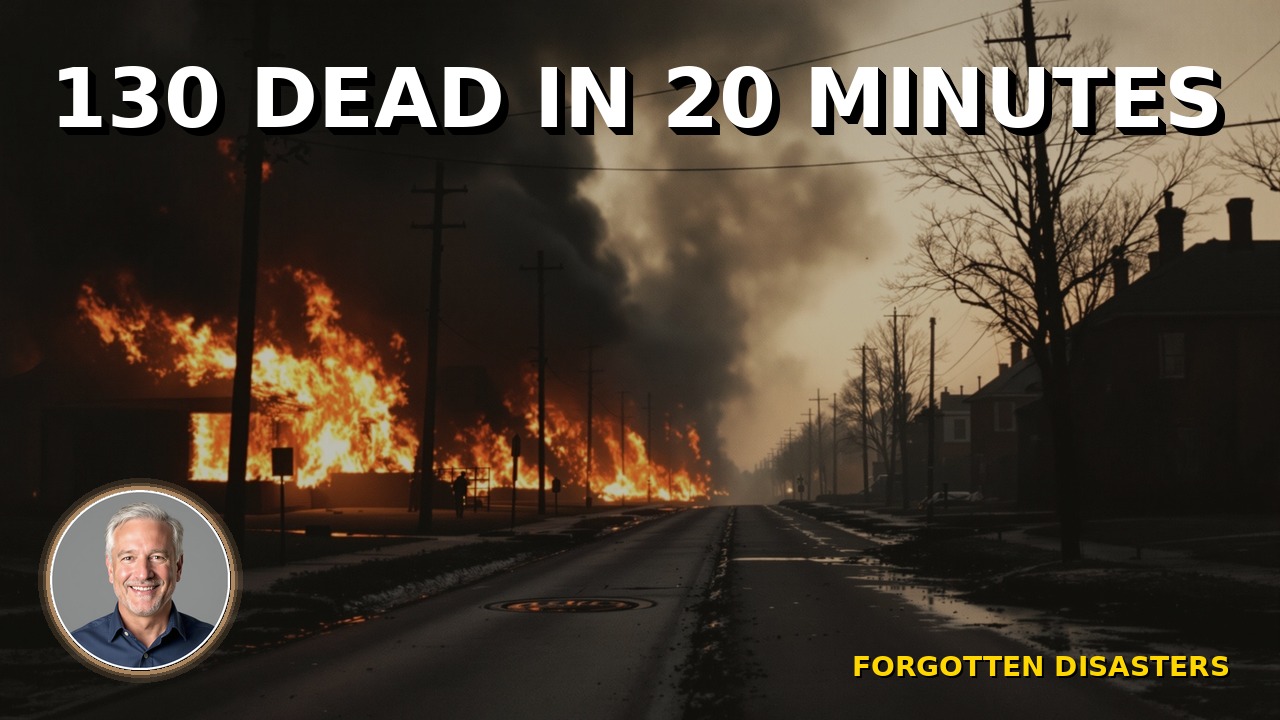
The Cleveland Gas Explosion of 1944: When Corporate Negligence Killed 130 in Twenty Minutes
On October 20, 1944, at 2:30 PM, Cleveland’s Saint Clair-Norwood neighborhood transformed into an industrial hellscape in less time than it takes to drink a cup of coffee. The East Ohio Gas Company’s liquefied natural gas storage facility had just failed catastrophically, sending invisible death flowing through the streets of a working-class immigrant community. What followed was not just one of America’s deadliest industrial disasters, but a case study in corporate negligence that would reshape how we think about industrial safety—and corporate accountability.
The story begins not with the explosion, but with a choice made two months earlier in a boardroom where profit margins mattered more than the lives of neighbors.
The Fatal Flaw Hidden in Plain Sight
E.R. Bowles knew his company had a problem. As the chief engineer who signed the August 1944 inspection report for East Ohio Gas Company, Bowles documented what he found in Tank 4: metal embrittlement caused by the extreme cold required to keep natural gas in liquid form. The steel, designed for above-ground storage of conventional materials, was literally becoming brittle at the -259°F temperatures needed for liquefied natural gas operations.
The report was explicit. The tank showed “definite signs of metal fatigue” and recommended immediate repairs or replacement. The cost: approximately $400,000—roughly $6.8 million in today’s currency.
East Ohio Gas Company executives made their choice. Instead of repairs, they opted for “enhanced monitoring procedures.” The decision saved the company hundreds of thousands of dollars. It would cost 130 of their neighbors their lives.
This wasn’t ignorance or accident. This was calculated risk management where the risk was borne entirely by people who had no voice in the decision.
The Invisible Killer: Why 1944’s Natural Gas Was Odorless
Modern natural gas carries that distinctive sulfur smell—mercaptan—added specifically to warn people of leaks. But in 1944, liquefied natural gas was odorless, colorless, and completely undetectable to human senses. When Tank 4 finally cracked open that October afternoon, the escaping gas was invisible death.
Liquefied natural gas is heavier than air when it first escapes, flowing like water into low-lying areas. It poured into basement windows, seeped through foundation cracks, and most dangerously, flowed into Cleveland’s sewer system. The interconnected network of underground pipes became a vast delivery system, carrying explosive vapor beneath an entire neighborhood.
The children walking home from school had no warning. The families in their kitchens preparing dinner had no indication that their basements were filling with explosive gas. The city’s infrastructure had become a bomb, and only East Ohio Gas Company knew it was armed.
Twenty Minutes of Hell: How the Explosion Unfolded
At approximately 2:40 PM, something—likely a car backfire or electrical spark—provided the ignition source. The explosion began underground. Manhole covers throughout the Saint Clair-Norwood neighborhood launched into the air like artillery shells. Sewer grates became flamethrowers. Then the houses began burning from their foundations up.
Because the gas had pooled in basements and lower levels, the fires started at ground level and climbed. Residents who ran upstairs—following every human instinct to seek higher ground—trapped themselves in buildings that were burning from below. Those who survived were largely those who ran immediately outside, counterintuitively fleeing toward the source of visible danger.
The East Ohio Gas Company facility itself became a secondary disaster. Additional storage tanks, heated by the initial explosion, began failing in sequence. Each new tank failure sent fresh waves of burning gas across the neighborhood. Emergency responders found themselves fighting not one fire, but dozens of interconnected blazes fed by an industrial facility that continued to fail.
By 3:00 PM, it was over. One hundred and thirty people were dead. Seven hundred and fifty were homeless. An entire neighborhood had been effectively erased.
The Human Cost: Cleveland’s Immigrant Community Pays the Price
The Saint Clair-Norwood neighborhood wasn’t chosen randomly for industrial development. Like many American cities in the 1940s, Cleveland had concentrated its most dangerous industrial facilities in areas populated primarily by recent immigrants and working-class families. The families who died that day were largely Eastern European immigrants who had come to Cleveland seeking industrial jobs and affordable housing.
These residents had no political influence over zoning decisions that placed a massive gas storage facility in their neighborhood. They had no representation in corporate boardrooms where cost-cutting decisions were made. They had no access to the engineering reports that documented the dangers they faced daily.
The demographic targeting wasn’t accidental. Industrial facilities were systematically located in communities with the least political power to resist them. The pattern established in Cleveland—where environmental risks are concentrated in politically powerless communities—remains visible in American industrial geography today.
Corporate Accountability: Why No Executive Went to Prison
Despite clear documentation of corporate negligence, no East Ohio Gas Company executive faced criminal charges. The August inspection report—evidence of deliberate disregard for documented safety risks—somehow failed to trigger criminal prosecution for the 130 deaths that followed.
The legal framework of 1944 treated industrial disasters as civil matters, not criminal ones. Families could sue for damages, but executives who made deadly decisions faced no personal consequences. The pattern established in Cleveland became the template for corporate accountability in industrial disasters: companies pay fines and settlements, executives remain untouched.
This legal precedent matters beyond historical curiosity. The same framework that protected East Ohio Gas Company executives in 1944 continues to shield corporate decision-makers today. When companies choose profit over safety and people die as a result, the legal system still struggles to treat those choices as criminal acts.
The Regulatory Response: How 130 Deaths Changed American Industry
The Cleveland explosion forced immediate changes in liquefied natural gas regulation. The federal government established new standards for storage tank materials, requiring steel specifically designed for extreme temperature applications. Regular safety inspections became mandatory, not optional. Most importantly, odorization requirements were expanded—ensuring that future gas leaks would be immediately detectable.
The disaster also effectively killed commercial LNG development in the United States for two decades. No community wanted to accept the risks that Cleveland had faced, and no company wanted to face the potential liability. American natural gas remained primarily in conventional pipeline form until the 1960s, when improved safety technologies finally made LNG storage acceptable to regulators and communities.
But the most significant regulatory change was philosophical. The Cleveland explosion demonstrated that industrial safety couldn’t be left to corporate self-regulation. When companies were allowed to make their own risk assessments about dangers faced by their neighbors, they consistently chose to externalize those risks onto communities with no power to refuse them.
The Modern Legacy: What Cleveland Teaches Us Today
The fundamental dynamic that killed 130 people in Cleveland persists in American industrial regulation. Companies still make risk assessments where they capture the profits while neighboring communities bear the dangers. Corporate executives still rarely face personal criminal liability for safety decisions that kill their neighbors.
Recent industrial disasters—from the 2005 BP Texas City refinery explosion to the 2013 West Fertilizer Company explosion in Texas—follow patterns established in Cleveland. Companies document safety risks, choose cheaper alternatives, and when disasters occur, pay civil penalties while executives avoid criminal prosecution.
The technical aspects have improved dramatically. Modern natural gas is odorized, storage materials are engineered for their applications, and emergency response systems are far more sophisticated. But the political and legal framework that allowed East Ohio Gas Company to externalize deadly risks onto their neighbors remains largely unchanged.
Understanding the Cleveland explosion isn’t just historical curiosity—it’s a blueprint for recognizing how industrial disasters happen. When you see companies choosing monitoring over repairs, when you see dangerous facilities concentrated in politically powerless communities, when you see executives avoiding personal accountability for deadly corporate decisions, you’re seeing the same pattern that killed 130 people in twenty minutes on October 20, 1944.
The children walking home from school that day deserved neighbors who couldn’t choose profit over their lives. We still haven’t built the legal and regulatory framework to guarantee that protection today.