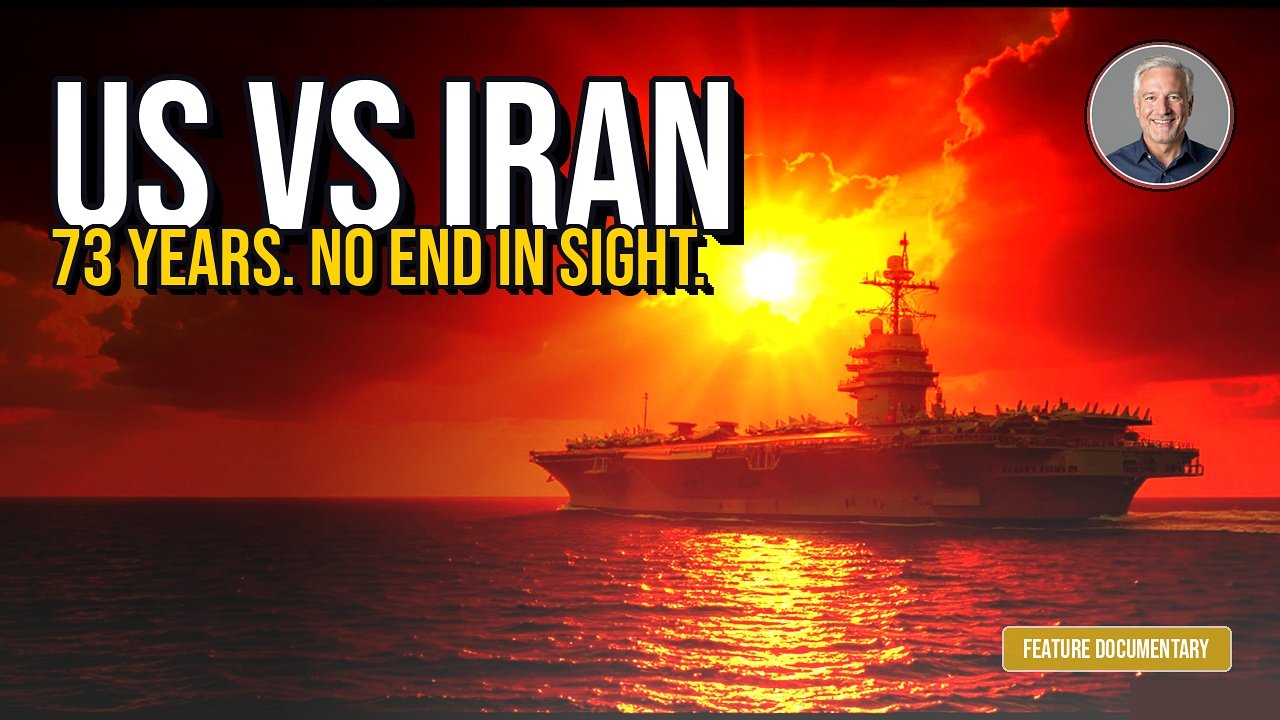
Three carrier strike groups in the Persian Gulf. Diplomatic silence from Tehran. To understand how we got here, you have to go back seventy-three years to a decision made in a Washington office that changed the entire Middle East.
Special Assignments
Why the US and Iran Have Been Enemies for 73 Years
What You'll Discover
- How a CIA-backed coup in 1953 planted the seeds of seven decades of conflict
- Why the Iranian Revolution shocked American intelligence agencies
- The full story of the 444-day hostage crisis and the failed rescue mission
- How the Iran-Iraq War created strange alliances that persist today
- Why the nuclear deal was signed, then abandoned, and what happened next
- Where US-Iran relations stand today and what the military buildup means
Frequently Asked Questions
The conflict between the United States and Iran traces back to 1953, when the CIA and British intelligence orchestrated Operation Ajax, overthrowing Iran's democratically elected Prime Minister Mohammad Mosaddegh to protect Western oil interests and restore Shah Mohammad Reza Pahlavi to power. The Shah's twenty-six years of authoritarian rule, backed by American support and enforced by his secret police, generated deep anti-American sentiment. When the Iranian Revolution brought Ayatollah Khomeini to power in 1979, the hostage crisis cemented mutual hostility. Every chapter since, including the Iran-Iraq War, proxy conflicts across the Middle East, the nuclear standoff, and the assassination of Qasem Soleimani in 2020, connects back to that original 1953 intervention. This documentary traces all seventy-three years of the relationship.
Operation Ajax was a joint CIA and MI6 covert operation executed in August 1953 that overthrew Iran's democratically elected Prime Minister Mohammad Mosaddegh and restored Shah Mohammad Reza Pahlavi to the Peacock Throne. Mosaddegh had nationalized Iran's oil industry, threatening the profits of the Anglo-Iranian Oil Company, today known as BP. The CIA organized street protests, bribed military officers, and coordinated with Iranian royalists to create chaos in Tehran. After an initial failed attempt, a second coup succeeded on August 19, 1953. The Shah ruled for twenty-six more years with American support, using his secret police force SAVAK to suppress dissent. The coup is widely regarded as the original sin of US-Iran relations, and Iranians have never forgotten that a foreign power removed their elected leader to protect oil profits.
The Iranian Revolution of 1979 was driven by decades of accumulated grievances against the Shah's authoritarian rule, which was propped up by American support following the 1953 CIA coup. The Shah modernized Iran's economy but suppressed political opposition through SAVAK, his feared secret police force. Economic inequality grew as oil wealth enriched elites while many Iranians remained poor. Religious leaders, leftist intellectuals, and ordinary citizens united against the regime. Ayatollah Ruhollah Khomeini, exiled to France, became the revolution's symbolic leader through smuggled cassette tape recordings of his sermons. Mass protests paralyzed the country in late 1978 and the Shah fled Iran in January 1979. Khomeini returned to Tehran on February 1, 1979, and established an Islamic Republic. The revolution shocked American intelligence agencies, who had confidently assessed that the Shah's grip on power was secure.
The Joint Comprehensive Plan of Action, commonly called the Iran nuclear deal or JCPOA, was signed in July 2015 by Iran and six world powers: the United States, United Kingdom, France, Germany, Russia, and China. Under the agreement, Iran accepted strict limits on its nuclear enrichment program, reduced its uranium stockpile by ninety-eight percent, allowed intrusive international inspections, and dismantled key nuclear infrastructure. In exchange, the international community lifted economic sanctions that had crippled Iran's economy. President Obama championed the deal as the best available path to preventing an Iranian nuclear weapon. President Trump withdrew the United States from the agreement in May 2018 and reimposed maximum pressure sanctions, arguing that the deal did not address Iran's missile program or regional activities. Iran subsequently resumed enrichment beyond the deal's limits.
Join the Discussion
Was the 2015 nuclear deal the best path to preventing an Iranian bomb, or did it legitimize a regime that would never honor its commitments? The arguments on both sides are stronger than most people realize.
Share Your Take on YouTube