London Bridge in Arizona: The Extraordinary Story Behind One of America’s Most Unlikely Landmarks
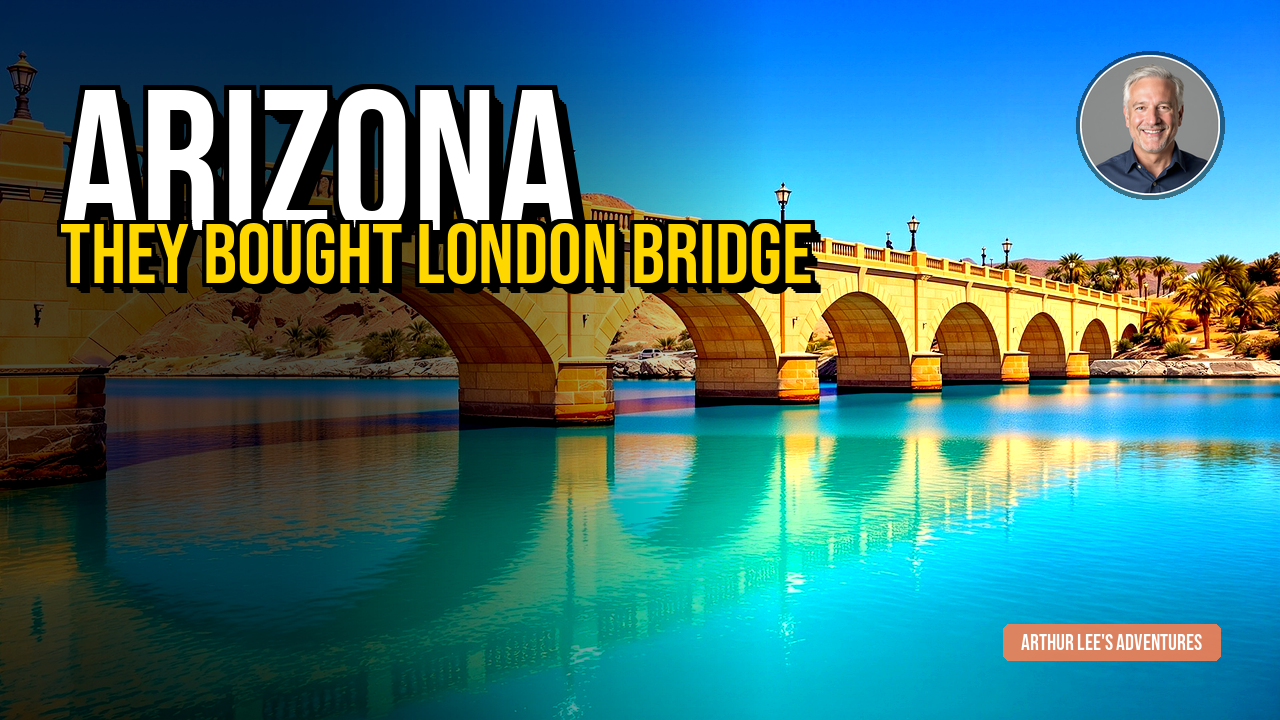
When most people think of London Bridge, they picture the Thames flowing beneath its historic arches. But since 1971, one of London’s most famous crossings has spanned the desert waters of Lake Havasu City, Arizona—6,000 miles from its original home. This remarkable relocation represents just one chapter in Arizona’s surprisingly rich tapestry of historical oddities, from military camels wandering the Sonoran Desert to the discovery of Pluto in a Flagstaff observatory.
The story of how London Bridge ended up in the American Southwest reveals not just an audacious act of 20th-century entrepreneurship, but also Arizona’s unique position as a crossroads of cultures, innovation, and ambitious dreams that have shaped the state from territorial days to the present.
The Great Bridge Sale: How London Bridge Came to Arizona
In 1967, the City of London faced a problem that would seem unthinkable today: their historic London Bridge, built in 1831, was sinking into the Thames. The granite structure, designed by engineer John Rennie, could no longer support modern traffic loads and was slowly succumbing to the weight of history. Rather than simply demolish this piece of British heritage, officials made an unprecedented decision—they would sell it.
Enter Robert McCulloch, an American entrepreneur and chainsaw manufacturer who had recently purchased 26 square miles of Arizona desert around Lake Havasu with plans to develop a resort community. When McCulloch learned that London Bridge was for sale, he saw an opportunity that others might have dismissed as folly. On April 18, 1968, McCulloch successfully bid $2.46 million for the bridge—approximately $20 million in today’s currency.
The logistics of moving a 130-year-old stone bridge across an ocean defied conventional wisdom. Each of the bridge’s 1,027 granite blocks was carefully numbered and cataloged before being dismantled. The stones were then shipped 10,000 miles around Cape Horn to the Port of Long Beach, California, and trucked across the Mojave Desert to Lake Havasu City. The reassembly process took three years and cost an additional $7 million, bringing the total investment to nearly $10 million.
When London Bridge officially reopened on October 10, 1971, it had become the world’s largest antique—and Arizona’s second-most-visited tourist attraction after the Grand Canyon. McCulloch’s gamble paid off spectacularly, drawing millions of visitors to his previously unknown desert development.
Arizona’s Unlikely Role in America’s Military Innovation
The London Bridge relocation exemplifies Arizona’s long history of hosting unlikely experiments. Perhaps none was more unusual than the U.S. Army Camel Corps, which operated in the territory from 1857 to 1866. Secretary of War Jefferson Davis, who would later become president of the Confederacy, championed the use of camels for military transportation in the American Southwest, reasoning that these “ships of the desert” would prove superior to horses and mules in Arizona’s harsh terrain.
The Army imported 77 camels from the Middle East, along with experienced Arab and Turkish handlers, establishing Camp Verde as the primary camel station. The experiment showed promise—camels could carry 600 pounds compared to a mule’s 200-pound capacity, and they required less water in the desert environment. However, the Civil War interrupted the program, and American soldiers never fully embraced their exotic mounts.
After the war, the Army auctioned off most camels to circuses and private buyers, though some escaped into the Arizona wilderness. For decades afterward, prospectors and travelers reported sightings of wild camels roaming the desert, with the last confirmed wild camel killed in Arizona in 1929. Today, a bronze camel statue in Quartzsite commemorates this forgotten chapter of American military history.
From Desert Observatory to Cosmic Discovery
Arizona’s clear skies and high altitude have made it a center for astronomical research since the early 20th century. Astronomer Percival Lowell established the Lowell Observatory in Flagstaff in 1894, initially to study Mars and search for signs of intelligent life. While Lowell’s theories about Martian canals proved incorrect, his observatory would achieve lasting fame through a different discovery.
On February 18, 1930, a young astronomer named Clyde Tombaugh, working at Lowell Observatory, discovered Pluto after comparing photographic plates taken six days apart. The discovery fulfilled Lowell’s prediction of a ninth planet beyond Neptune, though Pluto was later reclassified as a dwarf planet in 2006. For 76 years, however, Arizona could claim the distinction of being the only state where a planet was discovered.
The observatory continues to operate today, and Flagstaff has been designated as the world’s first International Dark Sky City, protecting the night skies that make astronomical observation possible. This commitment to preserving natural darkness stands in stark contrast to the neon-lit tourist attractions like London Bridge that have also become part of Arizona’s identity.
Geronimo and the End of an Era
While entrepreneurs were shipping bridges across oceans and astronomers were discovering planets, Arizona’s transformation from territory to state was shaped by conflict between indigenous peoples and American settlers. The Apache Wars, which raged intermittently from the 1850s through the 1880s, culminated in the surrender of Geronimo, the last major Native American leader to resist U.S. authority.
Geronimo, whose Apache name was Goyaałé, led a small band of Chiricahua Apache in a campaign of resistance that captured national attention. His final surrender on September 4, 1886, at Skeleton Canyon near the Arizona-Mexico border, effectively ended the Apache Wars and cleared the way for Arizona’s full integration into the United States. Geronimo and his followers were sent into exile in Florida, Alabama, and finally Oklahoma, where he died in 1909, never returning to his Arizona homeland.
The end of armed resistance by Native peoples coincided with Arizona’s push for statehood. The territory had been seeking admission to the Union since the 1890s, but Congress was reluctant to admit what it saw as a sparsely populated, economically undeveloped region. Arizona finally achieved statehood on February 14, 1912, becoming the 48th state—notably, the last of the contiguous United States to join the Union.
Engineering Marvels Past and Present
The ambitious engineering required to relocate London Bridge reflects a tradition of large-scale infrastructure projects that spans Arizona’s entire recorded history. Long before European contact, the Hohokam people constructed an extensive canal system throughout the Salt River Valley, some portions of which still influence the layout of modern Phoenix’s water infrastructure.
These ancient canals, built between 1 and 1450 CE, represented one of the most sophisticated irrigation systems in prehistoric North America. The Hohokam moved water across hundreds of miles, transforming desert into agricultural land that supported a population estimated at 80,000 people at its peak. When American settlers arrived in the Salt River Valley in the 1860s, they often followed the routes of these ancient waterways, recognizing the engineering wisdom of their predecessors.
The tradition continued into the 20th century with projects like the Theodore Roosevelt Dam, completed in 1911, and the Central Arizona Project, which brings Colorado River water across 336 miles of desert to Phoenix and Tucson. In this context, moving London Bridge stone by stone across an ocean seems less like an eccentric millionaire’s folly and more like the continuation of a millennium-long tradition of ambitious desert engineering.
The Napster Connection: Arizona’s Digital Age Pioneer
Arizona’s role in American innovation extends beyond bridges and telescopes into the digital age. Shawn Fanning, creator of Napster—the peer-to-peer file-sharing service that revolutionized music distribution—was born in Brockton, Massachusetts, but spent crucial formative years in Arizona before attending Northeastern University. Fanning developed Napster in 1999 as a freshman, creating software that allowed users to share MP3 files directly with each other.
While Napster faced legal challenges from the music industry and was eventually shut down in 2001, it fundamentally changed how people consume music and laid the groundwork for streaming services like Spotify and Apple Music. Fanning’s innovation demonstrated how digital technology could disrupt established industries—a pattern that continues to shape Arizona’s growing tech sector in cities like Phoenix and Tempe.
The State That Says No to Daylight Saving Time
Among Arizona’s quirks is its relationship with time itself. Most of Arizona does not observe Daylight Saving Time, a decision that dates back to 1968 when the Uniform Time Act allowed states to opt out. Arizona chose to remain on Mountain Standard Time year-round, reasoning that extending daylight hours during summer months would increase energy consumption for air conditioning—the opposite effect intended by Daylight Saving Time.
The Navajo Nation, which spans parts of Arizona, Utah, and New Mexico, does observe Daylight Saving Time, creating the unusual situation where travelers can cross multiple time zones while remaining within Arizona’s borders. The Hopi Reservation, which is entirely surrounded by Navajo land, follows the state’s lead and does not change its clocks, adding another layer of temporal complexity to northeastern Arizona.
Legacy and Modern Relevance
The story of London Bridge’s journey to Arizona illuminates broader themes about American identity, entrepreneurship, and the relationship between preservation and innovation. McCulloch’s decision to purchase and relocate a piece of British history reflects the American tendency to reinvent Old World traditions in New World settings—a pattern visible from Colonial Williamsburg to Las Vegas’s European-themed casinos.
Today, Lake Havasu City’s London Bridge attracts over one million visitors annually, validating McCulloch’s belief that authentic historical artifacts could anchor modern tourist destinations. The bridge’s success helped establish a template for heritage tourism that has been replicated across the American West, from restored mining towns to relocated historical buildings.
The broader collection of Arizona’s historical oddities—from military camels to astronomical discoveries—reveals a state that has consistently served as a laboratory for American experimentation. Whether driven by military necessity, scientific curiosity, or entrepreneurial ambition, Arizona has hosted ventures that seemed improbable at the time but often proved prescient.
As Arizona continues to grow—the state’s population has increased by over 600% since London Bridge was relocated—these historical episodes provide perspective on a place that has always attracted visionaries, dreamers, and those willing to attempt the seemingly impossible. In a state where London Bridge spans a desert lake, where camels once carried military supplies, and where Pluto was discovered through patient observation of the night sky, the improbable has become part of the landscape itself.