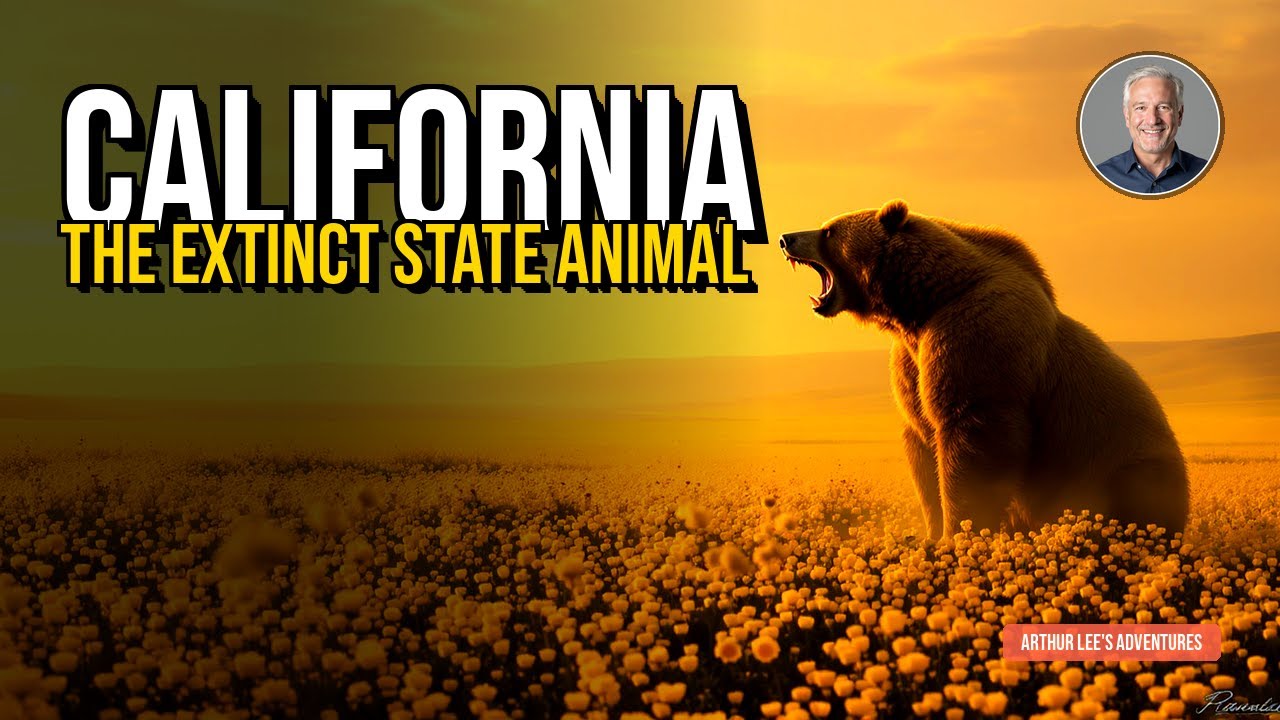
California Put an Extinct Animal on Its State Flag: The Untold Stories of the Golden State
California’s official state flag proudly displays a magnificent grizzly bear striding across white fabric—an animal that hasn’t roamed the state’s wilderness since 1924. This ironic symbol represents just one layer of California’s complex and often surprising history, filled with disasters that reshaped geography, brief republics, wartime attacks, and gold discoveries that changed the world.
The Last California Grizzly: A Symbol of What We Lost
The California grizzly bear (Ursus californicus) once numbered in the tens of thousands across the state. These massive predators, weighing up to 800 pounds, dominated California’s ecosystem from the Pacific coast to the Sierra Nevada mountains. Spanish explorers in the 1700s named the region “the land of the bears” after encountering these formidable creatures.
But the bear that adorns California’s flag today represents one of conservation’s greatest failures. The last confirmed California grizzly was shot in Tulare County in August 1922, though unverified sightings continued until 1924. Within just 75 years of the Gold Rush beginning in 1848, European-American settlers had completely eliminated a species that had thrived for thousands of years.
The bear’s extinction came from systematic hunting campaigns, habitat destruction, and competition for resources during California’s rapid development. Ranchers viewed grizzlies as livestock threats, miners saw them as dangerous obstacles, and trophy hunters pursued them for sport. By 1900, fewer than 50 California grizzlies remained in the wild.
Ironically, the grizzly bear had already been chosen as California’s symbol during the short-lived Bear Flag Republic of 1846, decades before anyone imagined the species would vanish entirely.
The 25-Day Republic That Almost Changed Everything
Most Americans learn that California joined the Union in 1850, but few know about the brief nation that preceded statehood. The California Republic, known as the Bear Flag Republic, existed for exactly 25 days in June and July 1846.
On June 14, 1846, a group of American settlers in Sonoma declared independence from Mexican rule. Led by William B. Ide, these rebels created their own flag featuring a grizzly bear and a red star, along with the words “California Republic.” The uprising began with the capture of Sonoma’s Mexican commandant, Mariano Vallejo, who ironically supported American annexation.
The republic’s independence ended abruptly on July 9, 1846, when U.S. Navy Commodore John D. Sloat raised the American flag in Monterey Bay, claiming California for the United States. The Bear Flag Republic became a historical footnote, but its symbol endured. California officially adopted the bear flag design as its state flag in 1911, long after the creature it depicted had begun its slide toward extinction.
Twelve Ounces That Changed the World
The California Gold Rush, one of the most significant mass migrations in human history, began with a discovery so small it could fit in your palm. On January 24, 1848, James Marshall found approximately 12 ounces of gold flakes in the American River at Sutter’s Mill in Coloma.
Marshall, a carpenter working for Swiss immigrant John Sutter, noticed shiny metal in the mill’s tailrace during routine maintenance. His initial find weighed less than a pound, but news of the discovery spread like wildfire despite Sutter’s attempts to keep it secret. By 1849, over 300,000 people had arrived in California from across the United States and around the world.
The Gold Rush transformed California from a sleepy Mexican territory with about 14,000 non-Native residents into a booming state with nearly 380,000 people by 1860. San Francisco grew from a village of 200 to a city of 36,000 in just two years. The influx of miners, merchants, and fortune-seekers created the economic foundation that would make California America’s most populous state.
But the Gold Rush also accelerated the California grizzly’s extinction. Miners viewed the bears as threats to their camps and claims, while the massive environmental disruption destroyed crucial habitat. The same economic boom that built modern California sealed the fate of its most iconic native species.
When the Los Angeles River Flowed Backward
One of California’s most catastrophic disasters literally changed the direction of the Los Angeles River—and most people have never heard of it. The St. Francis Dam disaster of March 12, 1928, killed over 400 people and temporarily reversed the flow of the LA River.
The St. Francis Dam, built by Los Angeles Department of Water and Power chief engineer William Mulholland, was designed to store water from the controversial Los Angeles Aqueduct. At 11:57 PM on March 12, the 185-foot concrete dam catastrophically failed, releasing 12.4 billion gallons of water in a matter of hours.
The resulting flood wave, initially 140 feet high, raced down the Santa Clara River Valley at speeds up to 18 miles per hour. The torrent carried away entire communities, including the town of Castaic Junction, and deposited debris as far as the Pacific Ocean near Ventura, 54 miles away.
Most remarkably, the massive volume of water and debris temporarily caused the Los Angeles River to flow backward from its mouth. The force of the floodwaters entering the ocean created a hydraulic dam effect, pushing seawater and sediment back upstream for several miles. This geographic anomaly lasted for nearly a week before normal flow patterns resumed.
The disaster ended Mulholland’s career and led to major reforms in dam engineering and safety oversight. Today, few physical traces of the St. Francis Dam remain, but the disaster fundamentally changed how California manages its water infrastructure.
The Night Japan Attacked the Mainland United States
While Pearl Harbor dominates discussions of Japanese attacks on American soil, the first assault on the U.S. mainland occurred off California’s coast. On February 23, 1942, Japanese submarine I-17 surfaced near Santa Barbara and shelled the Ellwood Oil Field in the only direct attack on the continental United States during World War II.
At 7:15 PM, submarine commander Kozo Nishino ordered his crew to fire on the coastal oil facilities. Over 25 minutes, the I-17 launched approximately 16 five-inch shells at the Bankline Oil Company refinery and surrounding infrastructure. While the attack caused minimal damage—estimated at $500-1000—it created massive psychological impact.
The Santa Barbara attack triggered widespread panic along the West Coast. Military authorities imposed blackouts from Los Angeles to Seattle, and thousands of Japanese Americans were moved inland from coastal areas. The incident contributed to the broader hysteria that led to Japanese American internment, one of the most shameful chapters in California history.
Ironically, Commander Nishino had personal motivation for targeting Ellwood. Before the war, he had visited the facility as a merchant marine officer and suffered an embarrassing fall into a cactus patch while touring the refinery. Local workers had laughed at the incident, and Nishino specifically requested permission to shell the location where he had been humiliated.
Hollywood’s Original Sign Said Something Completely Different
The iconic Hollywood sign, perhaps California’s most recognizable landmark, originally advertised something entirely different. When erected in 1923, the sign read “HOLLYWOODLAND” and served as a massive billboard for a luxury housing development.
Los Angeles Times publisher Harry Chandler and his partners spent $21,000 to build the sign as a temporary advertisement for their upscale residential project in the Hollywood Hills. Each letter stood 30 feet wide and 50 feet tall, studded with 4,000 light bulbs that could be seen from 25 miles away.
The sign was designed to last only 18 months, but it became such an integral part of Los Angeles’ identity that it remained standing. By the 1940s, the “LAND” portion had deteriorated badly, and the Hollywood Chamber of Commerce removed those four letters in 1949, creating the nine-letter sign we know today.
The Hollywood sign survived multiple threats over the decades, including a 1978 renovation campaign that attracted donors like Hugh Hefner and Alice Cooper, who each sponsored individual letters. Today, the sign is protected as a cultural landmark, though it still requires constant maintenance and security to prevent vandalism and unauthorized climbing.
The Broader Pattern: Progress and Loss in the Golden State
California’s history reveals a consistent pattern of rapid development accompanied by irreversible loss. The same forces that created the state’s economic prosperity—the Gold Rush, agricultural expansion, urban development, and entertainment industry—also destroyed much of what made California unique.
The extinction of the California grizzly represents this broader theme. The bear disappeared not through malice, but through the accumulated effects of progress: habitat conversion, resource competition, and the simple human tendency to eliminate perceived threats. By the time Californians recognized what they were losing, it was too late.
This pattern continues today. California faces ongoing challenges balancing growth with conservation, from housing development in wildfire-prone areas to water allocation during persistent droughts. The state that put an extinct animal on its flag serves as a reminder that some losses cannot be undone, no matter how much we later regret them.
The grizzly bear on California’s flag is more than a symbol—it’s a warning. It reminds us that progress without wisdom can eliminate the very things that make a place worth preserving. In a state built on dreams of transformation, the extinct bear stands as a permanent monument to the price of change.