The Hidden Nuclear Secrets and Forgotten Stories That Shaped Modern Florida
Florida’s gleaming beaches and theme parks mask a darker, more complex history than most visitors—or even residents—realize. From NASA’s classified nuclear rocket program that could have revolutionized space travel to systematic campaigns of violence that erased entire communities from the map, the Sunshine State’s past reveals a pattern of secrecy, ambition, and human cost that continues to influence American politics and society today.
NASA’s Secret Nuclear Rocket Program: Project NERVA’s Florida Connection
Between 1961 and 1973, NASA operated one of the most ambitious and classified programs in American space history. The Nuclear Engine for Rocket Vehicle Application (NERVA) program represented a quantum leap beyond conventional chemical rockets, promising to cut Mars travel time from years to mere months. What most people don’t know is that significant portions of this program operated out of Florida facilities, hidden within the broader Kennedy Space Center operations.
The nuclear thermal rocket engines developed under NERVA generated thrust by heating liquid hydrogen to extreme temperatures using a nuclear reactor, achieving specific impulse ratings nearly twice that of chemical rockets. Ground tests at the Nevada Test Site demonstrated the technology’s viability, with some engines running for over an hour at temperatures exceeding 4,000 degrees Fahrenheit.
Florida’s role extended beyond simple logistics. The state’s coastal location made it ideal for theoretical nuclear rocket launches, as any potential accident would send debris over the Atlantic rather than populated areas. NASA engineers secretly modified launch facilities to accommodate nuclear engines, though public launches never occurred. The program’s cancellation in 1973, officially due to budget constraints, came after $1.4 billion in expenditures—roughly $8 billion in today’s currency.
The secrecy surrounding NERVA reflected broader Cold War paranoia about nuclear technology. Residents living near Kennedy Space Center had no idea their proximity to nuclear rocket development, raising questions about government transparency that echo in contemporary debates over military testing and public disclosure.
The Conch Republic: When Key West Declared War on America
On April 23, 1982, the Conch Republic of Key West became the only American city to officially declare war on the United States—and surrender the same day. This wasn’t a publicity stunt born from tourist board marketing; it was a genuine protest against federal policies that threatened to strangle the local economy.
The U.S. Border Patrol had established a roadblock at the Last Chance Saloon, the only land route connecting the Florida Keys to the mainland. Every vehicle was stopped and searched for illegal immigrants and drugs, creating traffic backups stretching for miles and effectively treating American citizens like foreign visitors entering their own country.
Key West Mayor Dennis Wardlow and the city council faced an impossible situation. Tourism, the lifeblood of the local economy, plummeted as visitors avoided the hours-long delays. Local businesses hemorrhaged money while federal officials dismissed their concerns.
The solution was characteristically Floridian in its audacity. At noon on April 23, Mayor Wardlow read a proclamation of independence, officially seceding from the United States. Prime Minister Wardlow then symbolically attacked a man in a Navy uniform with a loaf of stale Cuban bread, immediately surrendered, and applied for $1 billion in foreign aid and war relief.
The theater worked. National media coverage brought attention to the Border Patrol’s heavy-handed tactics, and the roadblock was eventually modified. The Conch Republic continues to exist as a “state of mind,” issuing novelty passports and maintaining its tongue-in-cheek independence movement.
The Rosewood Massacre: How Racial Violence Erased a Florida Town
In January 1923, the prosperous African American community of Rosewood, Florida, was systematically destroyed by white mobs in one of the most devastating episodes of racial violence in American history. Within a week, a thriving town of approximately 300 residents was reduced to ashes and abandoned land, its very existence nearly erased from historical memory.
Rosewood represented the possibility of Black economic independence in Jim Crow-era Florida. The community boasted successful businesses, a school, churches, and a Masonic lodge. Many residents worked in the nearby Sumner sawmill, while others operated independent farms and enterprises. This prosperity made Rosewood a target for resentment among some white residents in the region.
The violence began on January 1, 1923, when Fannie Taylor, a white woman in nearby Sumner, claimed she had been assaulted by an unknown Black man. Without evidence or investigation, white mobs assumed the perpetrator came from Rosewood. Over the following days, armed groups surrounded the town, shooting residents and burning buildings.
The final assault came on January 7, when an estimated 200-300 armed white men attacked Rosewood directly. Residents fled into the surrounding swamps and forests, with many never returning. Official death tolls were suppressed, but survivor testimonies suggest at least eight people died, with the true number likely much higher.
Unlike many historical atrocities, the Rosewood massacre eventually received official recognition. In 1994, Florida became the first state to compensate survivors and descendants of racial violence, paying $2.1 million to families and establishing a scholarship fund. The legislation followed years of investigation that confirmed survivor testimonies and documented the systematic destruction of the community.
Charles Ponzi’s Florida Land Scheme: The Scammer’s Second Act
Before his name became synonymous with financial fraud, Charles Ponzi attempted a comeback in 1920s Florida through an elaborate real estate scam that exploited the state’s land boom. After serving federal prison time for his famous postal reply coupon scheme, Ponzi arrived in Florida in 1925, drawn by the speculative frenzy surrounding undeveloped land.
Operating under the name Charles Bianchi, Ponzi established the Charpon Land Syndicate, promising investors massive returns on swampland purchases near Jacksonville. His sales pitch capitalized on legitimate Florida development success stories, particularly Henry Flagler’s remarkable railroad and hotel empire, to convince northern investors that worthless wetlands would become valuable developments.
Ponzi’s Florida operation revealed his evolution as a con artist. Rather than the complex financial instruments of his Boston scheme, the land fraud relied on simpler deception: selling the same parcels to multiple buyers, misrepresenting property locations, and promising infrastructure improvements that would never materialize. He sold underwater lots as “prime commercial real estate” and swampland as “future resort destinations.”
The scheme collapsed in 1926 when Florida’s real estate bubble burst, leaving investors with worthless deeds to nonexistent properties. Ponzi was arrested, tried, and sentenced to additional prison time. Upon release, he was deported to Italy, ending his American criminal career.
Ponzi’s Florida activities demonstrated how economic booms create perfect conditions for large-scale fraud. His success depended on legitimate development stories like Flagler’s achievements, lending credibility to obviously impossible claims. This pattern repeats throughout Florida history, from 1920s land speculation to modern cryptocurrency schemes.
Henry Flagler’s Impossible Railroad: Engineering Marvel or Reckless Gamble?
Henry Flagler’s overseas railroad to Key West, completed in 1912, represents one of the most ambitious infrastructure projects in American history. The 128-mile extension from Homestead to Key West required building across open ocean, through hurricane-prone waters, using early 20th-century technology. Critics called it “Flagler’s Folly,” but the railroad operated successfully for 23 years before the devastating 1935 Labor Day Hurricane destroyed much of the line.
The engineering challenges were staggering. Workers constructed 42 bridges, including the Seven Mile Bridge, then the longest segmental bridge in the world. The project required importing massive amounts of concrete, steel, and equipment to remote keys with no existing infrastructure. Construction crews lived in floating dormitories and work trains, enduring brutal heat, mosquitoes, and the constant threat of hurricanes.
Flagler invested approximately $27 million in the railroad—roughly $700 million today—driven by his vision of Key West as a major port for Caribbean and South American trade. The Panama Canal’s construction made this dream seem realistic, as Key West offered the closest deep-water harbor to the canal’s Atlantic entrance.
Labor conditions on the railroad were harsh even by early 1900s standards. Workers, many of them African American and Caribbean immigrants, faced dangerous conditions with minimal safety equipment. The 1906 hurricane killed over 100 workers, though exact numbers remain disputed due to poor record-keeping and racial discrimination in casualty reporting.
The railroad’s destruction in 1935 marked the end of Flagler’s transportation empire, but its legacy endures. The concrete and steel infrastructure became the foundation for the modern Overseas Highway (U.S. Route 1), still the only land route to Key West. Flagler’s railroad bridges, adapted for automobile use, continue carrying thousands of vehicles daily, testament to the original construction’s quality.
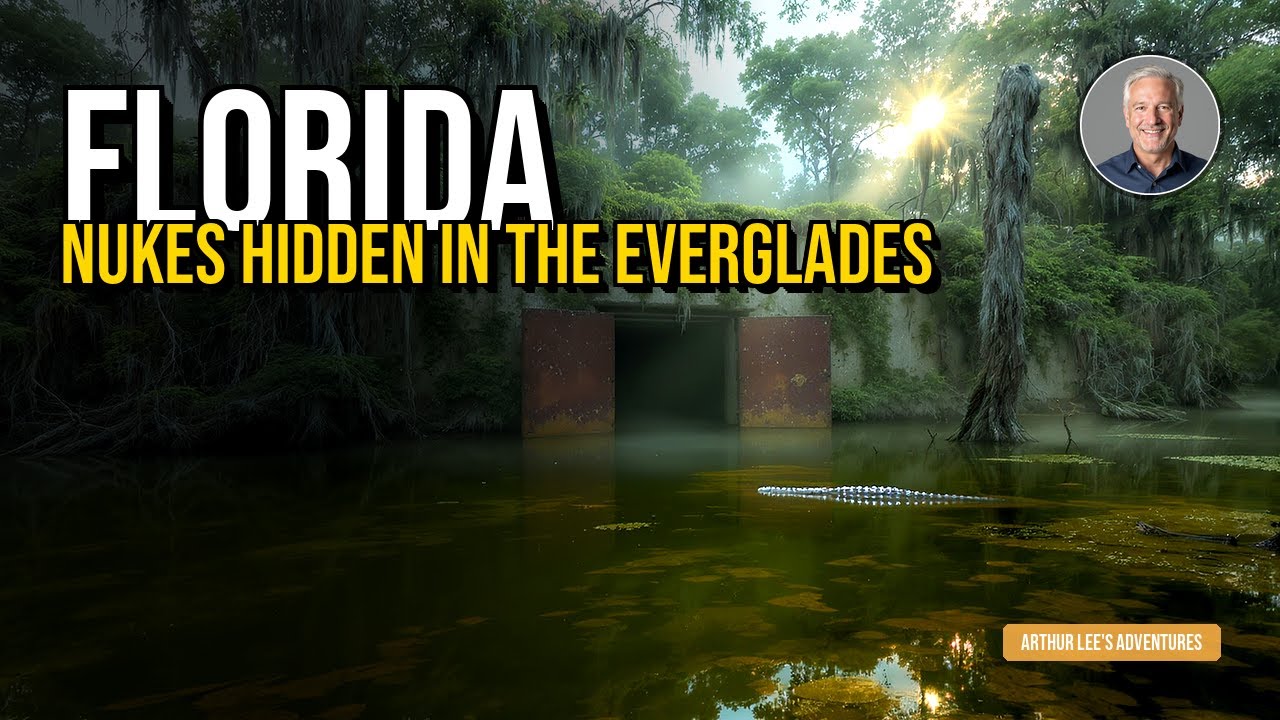
Nuclear Missiles in the Everglades: Cold War Secrets in Paradise
During the height of the Cold War, the U.S. military secretly installed Nike Hercules surface-to-air missile sites throughout Florida, including locations dangerously close to populated areas. These installations, designed to defend against Soviet bomber attacks, brought nuclear warheads within miles of civilian communities without public notification or consultation.
The Nike Hercules program represented America’s attempt to create an impenetrable air defense network. Each site contained multiple missiles equipped with either conventional or nuclear warheads, capable of destroying entire bomber formations. Florida’s strategic importance—protecting the Panama Canal approaches, Kennedy Space Center, and major military installations—justified extensive Nike deployments.
Sites operated near Miami, Tampa, Jacksonville, and other major cities, hidden behind chain-link fences and “Authorized Personnel Only” signs. Local residents might notice unusual construction activity or military traffic, but official explanations cited “communications facilities” or “radar installations.” The presence of nuclear weapons remained classified for decades.
The secrecy extended to local government officials. Mayors, county commissioners, and even some state legislators had no knowledge of nuclear weapons in their jurisdictions. Emergency responders received no training for nuclear accidents, and evacuation plans didn’t account for potential missile site disasters.
This pattern of nuclear secrecy wasn’t unique to Florida, but the state’s rapid population growth during the Cold War meant more civilians lived unknowingly near nuclear weapons than almost anywhere else. Retirement communities, suburban developments, and tourist attractions operated within potential blast radii of military installations designed to detonate nuclear warheads overhead.
Greek Sponge Divers: Building Florida’s Forgotten Maritime Empire
Tarpon Springs, Florida, became the unlikely center of America’s sponge diving industry through Greek immigration and entrepreneurship that transformed both the local economy and diving technology. Beginning in the 1890s, Greek sponge merchants and divers established operations that dominated Mediterranean-style sponge harvesting in American waters, creating a unique cultural enclave that persists today.
The Greeks brought revolutionary diving techniques to Florida waters. Traditional sponge harvesting used long poles to hook sponges from shallow water, limiting access to high-quality deep-water specimens. Greek divers used heavy canvas suits, copper helmets, and air pumps to reach depths of 100 feet or more, accessing previously untouchable sponge beds in the Gulf of Mexico.
John Cocoris, often credited with establishing Tarpon Springs’ sponge industry, arrived in 1896 and immediately recognized the Gulf’s potential. He recruited experienced divers from Greece, offering higher wages and better working conditions than Mediterranean operations. By 1910, Tarpon Springs hosted over 1,500 Greek residents and produced 90% of America’s natural sponges.
The industry’s peak came during the 1930s, when Tarpon Springs’ sponge fleet included over 200 boats employing more than 2,000 people. Annual harvests exceeded one million sponges, shipped worldwide for commercial and personal use. The Greek community maintained strong cultural traditions, establishing Orthodox churches, schools teaching Greek language, and businesses serving Greek cuisine.
World War II devastated the industry through a combination of military restrictions, labor shortages, and synthetic sponge development. Post-war recovery proved impossible as artificial sponges captured most commercial markets. By the 1960s, sponge diving had declined to a handful of boats serving primarily tourist markets.
Connecting Past to Present: Florida’s Pattern of Secrecy and Speculation
These seemingly disparate stories reveal consistent patterns in Florida’s development: ambitious projects pursued without full public disclosure, economic booms built on questionable foundations, and government secrecy justified by national security concerns. From Henry Flagler’s railroad gamble to NASA’s nuclear rocket program, Florida has repeatedly served as a testing ground for schemes too risky or controversial for other locations.
The state’s rapid growth, transient population, and distance from traditional power centers created ideal conditions for both legitimate innovation and elaborate deception. Entrepreneurs like Flagler succeeded through genuine vision and massive investment, while con artists like Ponzi exploited the same boom atmosphere for personal gain. Government agencies found Florida’s geography perfect for classified military programs, often at civilian expense.
Modern Florida continues this tradition. The state hosts private space launches, cryptocurrency experiments, and real estate speculation that echoes 1920s land booms. Contemporary debates over government transparency, from military testing to environmental data, mirror Cold War-era arguments about nuclear missile sites and classified rocket programs.
Understanding Florida’s hidden history provides context for ongoing political and economic developments. The state’s role as America’s testing ground for ambitious projects—legitimate and fraudulent—continues influencing