The Untold Secrets of Georgia’s Past: A Deeper Look at Hidden History
The Secret Hours That Changed World War II
On the afternoon of April 12, 1945, Franklin Delano Roosevelt sat for what would become his final presidential portrait at his beloved retreat in Warm Springs, Georgia. The artist, Elizabeth Shoumatoff, later recalled that the President appeared unusually tired but determined to complete the sitting. At 1:15 PM, Roosevelt suddenly pressed his left hand to his forehead and uttered his final words: “I have a terrific headache.”
What followed were perhaps the most crucial secret hours in American wartime history. For nearly four hours, Roosevelt’s death was known only to a handful of individuals at the Little White House, while the fate of the war—and the nascent United Nations—hung in the balance. During this critical window, Vice President Harry S. Truman remained unaware that he was about to inherit not only the presidency but also the most closely guarded secret in military history: the Manhattan Project.
The delay in announcing Roosevelt’s death wasn’t mere protocol. Georgia had become the epicenter of a carefully orchestrated transition of power that would reshape the final months of World War II and the entire postwar order. This moment exemplifies how Georgia has repeatedly found itself at the crossroads of pivotal American moments—often in ways that never made it into standard history books.
The Revolutionary War’s Forgotten Foreign Hero
Long before Georgia became Roosevelt’s sanctuary, it served as the unlikely stage for one of the Revolutionary War’s most intriguing figures. Count Casimir Pulaski, the Polish nobleman often called the “Father of American Cavalry,” met his fate during the 1779 Siege of Savannah—but not in the way most textbooks describe.
Recent forensic evidence suggests that Pulaski, who had been wounded during the assault on British positions, may have died aboard a ship in Savannah’s harbor rather than immediately on the battlefield. More remarkably, modern DNA analysis conducted in 2019 revealed that Pulaski likely had a rare intersex condition, challenging our understanding of this Revolutionary War hero’s personal story.
The Battle of Savannah itself represents one of the war’s most diverse engagements, featuring American colonists, French naval forces, Haitian volunteers, and Polish cavalry fighting together against British and Hessian troops. This multicultural alliance in coastal Georgia foreshadowed the complex international relationships that would define America’s future—yet it remains largely absent from popular Revolutionary War narratives.
The Cherokee Tragedy: A Calculated Dispossession
The Cherokee removal from Georgia between 1838 and 1839 represents more than a tragic chapter in American Indian policy—it was the culmination of a systematic legal and political campaign that redefined federal-state relationships and set precedents still debated today.
What makes Georgia’s role particularly significant is how the state deliberately defied federal authority to achieve its goals. In 1832, the Supreme Court ruled in Worcester v. Georgia that the federal government, not individual states, held authority over Native American nations. Georgia simply ignored the ruling, continuing to survey Cherokee lands and prepare for their seizure.
The discovery of gold near Dahlonega in 1829 had transformed Cherokee removal from a matter of agricultural expansion into a question of mineral wealth. The Georgia Gold Rush, America’s first major gold rush, generated an estimated $1 million in gold annually (equivalent to roughly $35 million today). This economic incentive provided the political pressure that made Cherokee removal not just desirable but, in the minds of Georgian politicians, inevitable.
The Trail of Tears that began in Georgia claimed approximately 4,000 Cherokee lives, but it also established legal precedents about state versus federal authority that would resurface during later constitutional crises, including the Civil War.
Andersonville: The Arithmetic of Suffering
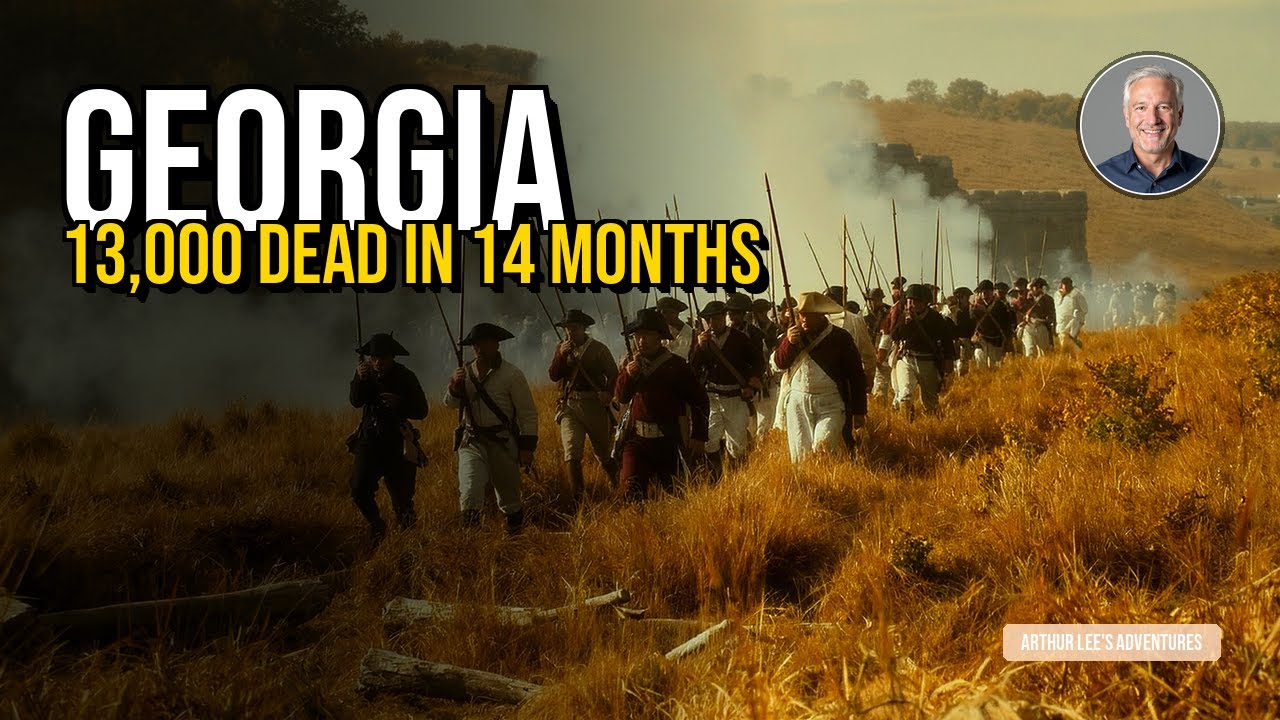
The Confederate prisoner-of-war camp at Andersonville represents one of the most documented humanitarian disasters in American history, yet its true significance extends beyond the immediate suffering it caused. Built in early 1864 to accommodate 10,000 Union prisoners, Andersonville held over 33,000 men at its peak—creating a population density that made it temporarily the fifth-largest city in the Confederacy.
Captain Henry Wirz, the Swiss-born commandant of Andersonville, became the only Confederate officer executed for war crimes after the conflict ended. However, Wirz’s trial and execution obscured the more complex reality of Confederate prison policy. Recent historical analysis suggests that the horrific conditions at Andersonville resulted less from deliberate cruelty than from the Confederate government’s complete inability to supply its own armies, much less enemy prisoners.
The camp’s mortality rate of approximately 29% reflected the broader collapse of Confederate logistics by 1864. More than 13,000 Union soldiers died at Andersonville, but Confederate forces in Georgia were simultaneously experiencing severe shortages of food, medicine, and basic supplies. The tragedy of Andersonville thus illuminates the total war strategy that characterized the conflict’s final phase.
The Federal Reserve’s Southern Genesis
The creation of America’s central banking system has unexpected Georgia connections that reveal how Southern political influence shaped national financial policy even after the Civil War. While the Federal Reserve Act was signed in 1913, the intellectual groundwork was laid partly through the financial innovations developed by Georgia’s post-Reconstruction cotton economy.
Georgia’s cotton factoring system—where merchants provided credit against future crops—created some of the most sophisticated agricultural financing mechanisms in the South. These systems influenced the regional Federal Reserve Bank structure, leading to the establishment of the Atlanta Federal Reserve Bank as the anchor for Southeastern monetary policy.
More intriguingly, several key Federal Reserve architects maintained strong Georgia connections. Paul Warburg, one of the system’s primary designers, regularly consulted with Atlanta banking leaders about regional credit needs. The Jekyll Island meeting of 1910, where much of the Federal Reserve’s structure was secretly planned, took place just off Georgia’s coast, highlighting the state’s role as neutral ground between Northern and Southern financial interests.
Coca-Cola’s Pharmaceutical Origins
John Stith Pemberton’s invention of Coca-Cola in Atlanta in 1886 represents more than the birth of a soft drink empire—it illustrates the complex intersection of medicine, marketing, and social change in the New South. Pemberton, a morphine-addicted Civil War veteran, originally marketed his creation as a patent medicine designed to cure headaches, anxiety, and depression.
The original Coca-Cola formula contained significant amounts of cocaine from coca leaves, leading to its early marketing as “the intellectual beverage” and “the temperance drink.” This pharmaceutical heritage meant that early Coca-Cola sales occurred primarily through drugstore soda fountains, creating the commercial model that would eventually spread American-style consumer culture globally.
Pemberton’s business partner, Asa Candler, recognized the product’s commercial potential and systematically removed its medicinal claims while expanding its availability. By 1895, Coca-Cola was being sold in every American state and territory—making it one of the first truly national consumer brands and establishing Atlanta as an unexpected center of American marketing innovation.
Hollywood’s Georgia Connections
The 1939 film “Gone with the Wind” cemented Georgia’s image in American popular culture, but the movie’s production reveals complex relationships between historical memory, commercial entertainment, and racial politics that extended far beyond Hollywood.
Hattie McDaniel’s Academy Award-winning performance as Mammy made her the first African American to win an Oscar, yet she was prohibited from attending the film’s Atlanta premiere due to racial segregation. This contradiction—celebrating a performance while excluding the performer—exemplified the broader tensions surrounding how popular culture represented the South.
The film’s Atlanta premiere became a three-day civic celebration that attracted over 300,000 visitors and generated millions of dollars in tourism revenue. This event established the template for using Hollywood productions to promote regional economic development, a strategy Georgia would later employ more systematically than any other state.
Margaret Mitchell’s original novel, published in 1936, had already become the fastest-selling novel in American publishing history, but the film’s success transformed Georgia’s tourism industry and established Savannah and Atlanta as major destination cities.
The First Woman Senator’s Controversial Legacy
Rebecca Latimer Felton’s appointment to the U.S. Senate in 1922 made her the first woman to serve in that body, but her 24-hour tenure represents one of the most complicated “firsts” in American political history. At 87, Felton was appointed to fill the seat left vacant by Thomas Watson’s death, but she served only one day before the newly elected Walter F. George claimed the position.
Felton’s brief Senate service occurred during a crucial period in American women’s political participation, just two years after the 19th Amendment guaranteed women’s suffrage. However, her political views included strong support for white supremacy and lynching, making her a problematic symbol for women’s political advancement.
Her appointment reflected Georgia’s complex relationship with progressive politics during the 1920s. While the state was willing to break gender barriers in political representation, it remained committed to maintaining racial segregation and limiting African American political participation.
Patterns of Power and Consequence
These hidden chapters of Georgia’s history reveal recurring patterns that extend far beyond state boundaries. Time and again, Georgia has served as a testing ground for broader American tensions: federal versus state authority, economic modernization versus traditional society, and competing visions of social justice.
The state’s geographic position between the established Eastern seaboard and the expanding Western frontier made it a natural laboratory for American experiments in democracy, capitalism, and social organization. From Cherokee removal to Roosevelt’s final retreat, Georgia has consistently found itself at the center of decisions that shaped national policy and international relations.
Perhaps most significantly, these stories demonstrate how local events can have global consequences. Roosevelt’s death in Warm Springs influenced the end of World War II and the beginning of the Cold War. The Federal Reserve Bank of Atlanta helped stabilize international cotton markets. Coca-Cola became America’s most recognizable global brand.
Understanding these connections helps explain why hidden history matters. The stories that don’t appear in textbooks often reveal the most about how power actually operates, how decisions really get made, and why the past continues to influence the present in unexpected ways. Georgia’s hidden history isn’t just about Georgia—it’s about understanding how American democracy actually functions, with all its contradictions, innovations, and unintended consequences.