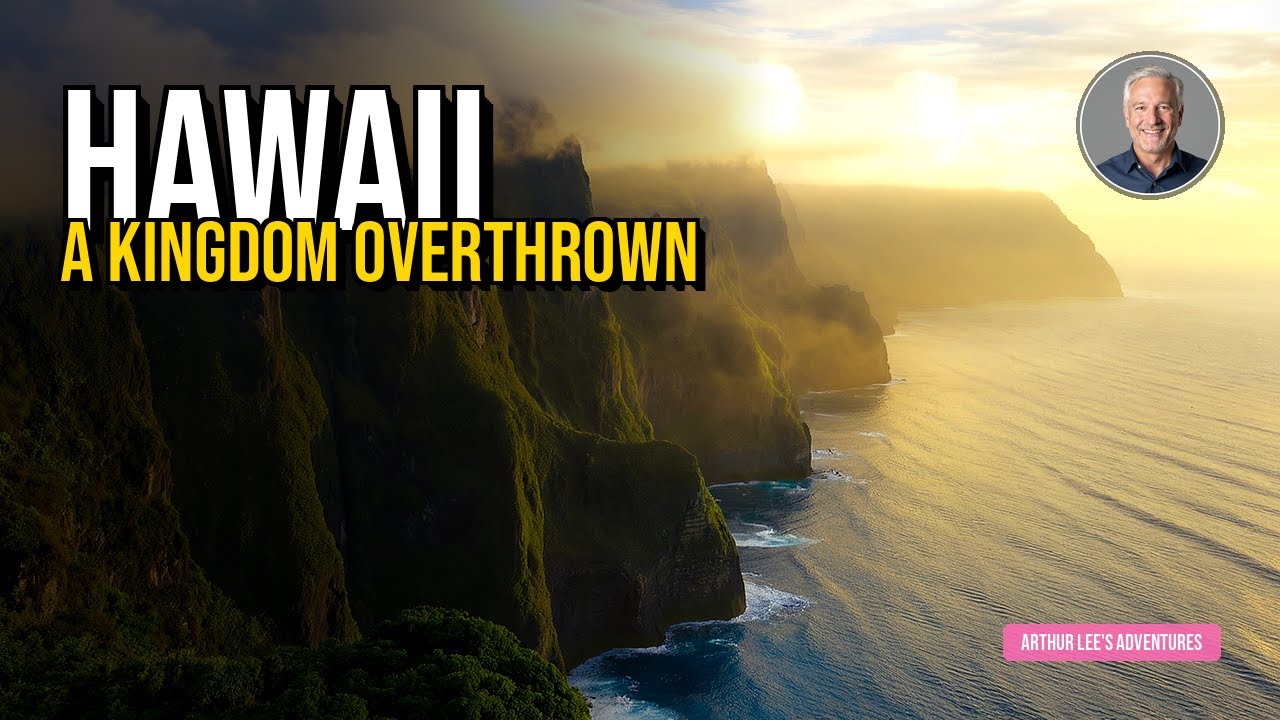
The Untold Story of Hawaii’s Stolen Kingdom: How 162 Marines Toppled a Queen in 1893
The gilded halls of Iolani Palace still echo with the footsteps of America’s only royal court—a magnificent structure that boasted electric lighting four years before the White House installed its first bulb. Yet most Americans remain unaware that this architectural marvel once housed a sovereign kingdom that fell not through war or natural decline, but through an orchestrated coup that a U.S. President would later condemn as fundamentally illegal.
On January 17, 1893, Queen Liliuokalani awoke as the ruler of an independent Pacific kingdom. By sunset, she was effectively a prisoner in her own palace, her government overthrown by American businessmen backed by 162 U.S. Marines who had no legal authority to intervene in Hawaiian affairs. This bloodless revolution would reshape the Pacific forever, yet it remains one of the most overlooked chapters in American imperial history.
The Last Queen of Hawaii: Liliuokalani’s Desperate Stand
Queen Liliuokalani ascended to Hawaii’s throne in 1891 following the death of her brother, King Kalakaua. At 52, she was no naive monarch—she was a accomplished composer, world traveler, and shrewd political observer who understood exactly what foreign sugar planters intended for her kingdom. Where her brother had been forced to accept the “Bayonet Constitution” of 1887, which stripped the monarchy of most governing power, Liliuokalani was determined to restore Hawaiian sovereignty.
Her fatal mistake, in the eyes of American plantation owners, was attempting to promulgate a new constitution in January 1893. This document would have returned voting rights to Native Hawaiians and Asian immigrants while reducing the political influence of foreign residents. For the sugar barons who had grown wealthy under favorable trade agreements, such democratic reforms represented an existential threat to their economic empire.
The queen’s constitutional proposal provided the pretext that American conspirators had been waiting for. Within days, a “Committee of Safety”—composed entirely of American and European businessmen—declared the Hawaiian government a threat to life and property. Their solution was as audacious as it was illegal: complete overthrow of the constitutional monarchy.
The 162 Marines: An Illegal Military Intervention
The most shocking aspect of Hawaii’s overthrow was not its inevitability, but its brazen illegality under both American and international law. When the Committee of Safety realized they lacked the military strength to topple Liliuokalani’s government, they turned to John L. Stevens, the American Minister to Hawaii, who had already exceeded his diplomatic authority by promising U.S. support for their cause.
On January 16, 1893, Stevens ordered Captain Gilbert Wiltse of the USS Boston to land 162 Marines and sailors in Honolulu under the pretense of protecting American lives and property. This military force, flying the American flag, took strategic positions around the city—not to protect American civilians, but to provide the firepower that Hawaiian revolutionaries lacked.
The legal precedent was clear: no foreign military had the right to intervene in Hawaii’s internal affairs. The Kingdom of Hawaii maintained diplomatic relations with major world powers, had signed treaties as a sovereign state, and operated under international law as an independent nation. Yet Stevens acted unilaterally, transforming what should have been a failed domestic rebellion into an American-backed coup d’état.
Queen Liliuokalani faced an impossible choice. She commanded a small but loyal Hawaiian guard, but engaging American forces meant war with the United States—a conflict that would result in massive bloodshed with no hope of victory. On January 17, 1893, she issued a statement yielding “to the superior force of the United States of America” while explicitly protesting the illegal nature of the intervention.
Iolani Palace: Symbol of a Stolen Sovereignty
Today, visitors to Iolani Palace marvel at its Victorian grandeur, but few understand they are walking through the scene of America’s only successful overthrow of a foreign government on what would become U.S. soil. Built between 1879 and 1882, the palace represented Hawaii’s emergence as a modern Pacific power, complete with telephone systems, electric lighting, and flush toilets—amenities that many American government buildings still lacked.
Following the coup, this technological marvel became the provisional government’s headquarters, its throne room converted into a capitol building for the newly declared Republic of Hawaii. In a bitter irony, the woman who had once hosted foreign dignitaries in these same halls was imprisoned here in 1895 following a failed counter-revolution, confined to a small upstairs room while facing charges of treason against the government that had stolen her throne.
The palace’s transformation from royal residence to republican capitol building symbolized a broader cultural destruction. Hawaiian language was banned in schools, traditional land tenure systems were dismantled, and Native Hawaiian political participation was systematically restricted. The overthrow was not merely a change of government—it was the beginning of a decades-long campaign to erase Hawaiian sovereignty from living memory.
The Forbidden Island: Niihau’s Unique Resistance
While most of Hawaii fell under American control, the privately owned island of Niihau emerged as an unexpected bastion of Hawaiian culture and language. Purchased by the Robinson family in 1864, this 70-square-mile island has remained largely closed to outsiders for over 150 years, creating a unique time capsule of pre-contact Hawaiian society.
Niihau’s isolation took on strategic significance during World War II when a Japanese Zero pilot crashed there following the Pearl Harbor attack. In an incident that reads like historical fiction, pilot Shigenori Nishikaichi attempted to escape the island with help from Japanese residents, leading to hand-to-hand combat with Native Hawaiian Ben Kanahele, who ultimately killed the armed pilot despite being shot three times.
This dramatic confrontation highlighted Niihau’s unique position in Hawaiian history—a place where traditional Hawaiian values and American patriotism coexisted, even as the broader island chain struggled with questions of identity and belonging in the aftermath of illegal annexation.
Three Years of Secret Martial Law
The attack on Pearl Harbor on December 7, 1941, triggered another constitutional crisis in Hawaii that remained classified for decades. Within hours of the Japanese assault, military authorities declared martial law and suspended the Hawaiian Territorial Constitution—a state of emergency that would secretly continue for nearly three years.
Under military rule, civilian courts were replaced by military tribunals, constitutional rights were suspended, and Hawaii effectively became an occupied territory under American military control. Workers were frozen in their jobs, movement between islands required military permits, and censorship was absolute. Most shocking of all, this suspension of constitutional government continued long after any reasonable military necessity had passed.
The martial law period revealed uncomfortable parallels to the 1893 overthrow—in both cases, constitutional government in Hawaii was suspended by American authorities who claimed emergency powers they did not legally possess. The Territory of Hawaii’s civilian government was not fully restored until October 1944, making this the longest suspension of constitutional rights in American history.
President Cleveland’s Damning Investigation
Perhaps the most remarkable aspect of Hawaii’s overthrow was the immediate American recognition that it constituted an illegal act. When President Grover Cleveland took office in March 1893, he ordered a comprehensive investigation into the Hawaiian revolution, appointing former Congressman James Blount as special commissioner to determine the facts.
Blount’s report, delivered in July 1893, was devastating in its conclusions. The investigation found that Minister Stevens had conspired with American businessmen to overthrow a friendly government, that U.S. military forces had been illegally deployed to support the revolution, and that the provisional government existed only through American military backing. Cleveland declared the overthrow an “act of war” committed without congressional authorization.
In an unprecedented move, President Cleveland demanded that the provisional government restore Queen Liliuokalani to her throne. However, the American-led Republic of Hawaii, now firmly in control, simply refused. Cleveland faced a constitutional crisis of his own—he could not legally use force to restore the queen without congressional approval, but Congress was increasingly dominated by expansionist sentiment that viewed Hawaiian annexation as inevitable.
The Modern Legacy: Sovereignty and Recognition
The illegal overthrow of Hawaii continues to reverberate through American politics more than 130 years later. In 1993, President Bill Clinton signed Public Law 103-150, known as the Apology Resolution, which formally acknowledged that the United States participated in the illegal overthrow of the Kingdom of Hawaii and apologized to Native Hawaiians for this historical injustice.
Yet formal apology has not translated into meaningful sovereignty restoration. The Hawaiian sovereignty movement encompasses a broad spectrum of approaches, from increased self-governance within the American federal system to complete independence and restoration of the Hawaiian Kingdom. Federal recognition of Native Hawaiians as an indigenous people—similar to the status of American Indian tribes—remains politically contentious and legally complex.
The story of Hawaii’s stolen sovereignty offers sobering lessons about the relationship between economic interests and political power, the fragility of international law, and the long-term consequences of expedient political decisions. In an era of renewed great power competition in the Pacific, understanding how Hawaii became American territory—through illegal overthrow rather than voluntary annexation—provides crucial context for contemporary debates about indigenous rights, territorial sovereignty, and the limits of legitimate government power.
The overthrow of Queen Liliuokalani was not an inevitable result of historical forces, but a specific choice made by specific individuals who prioritized economic advantage over legal principle. That choice continues to shape Hawaiian society today, reminding us that historical injustices rarely remain safely confined to the past—they live on in the institutions, inequalities, and unresolved questions that define our present.