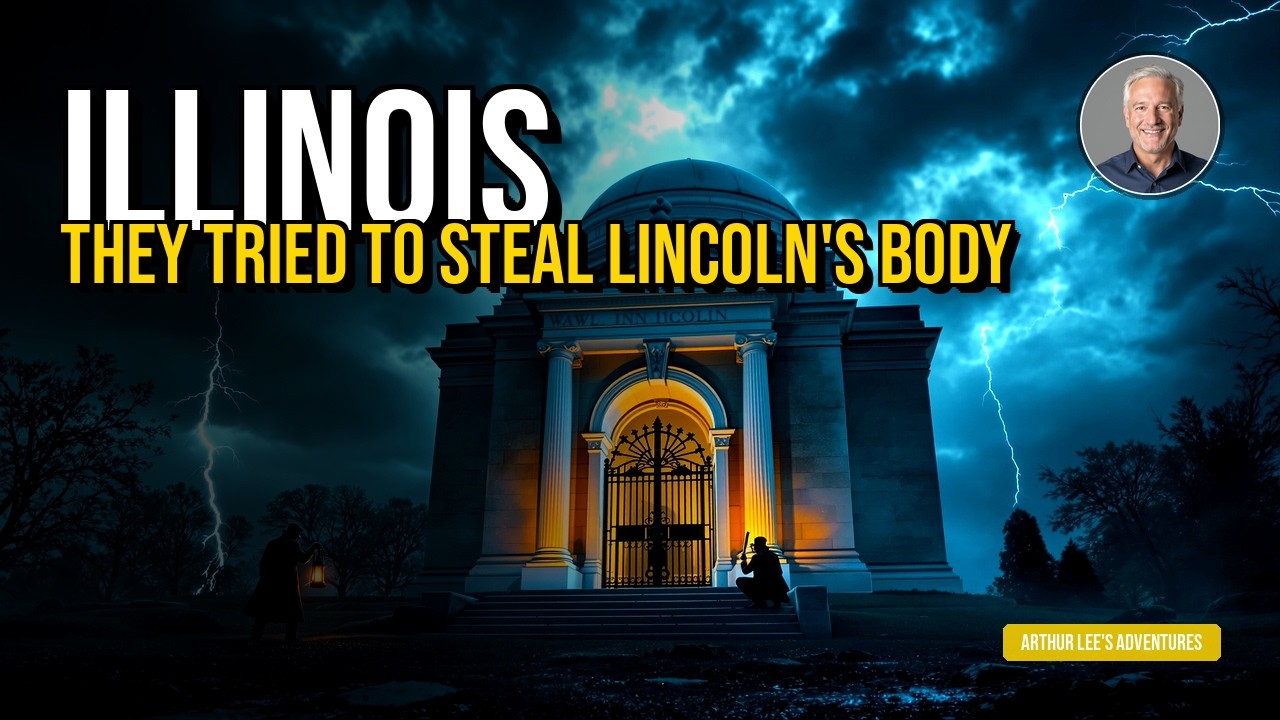
The Plot to Steal Lincoln’s Body: America’s Most Audacious Graverobbing Scheme
On the night of November 7, 1876—exactly eleven years after Abraham Lincoln’s assassination—a small gang of Chicago counterfeiters crept through the shadows of Springfield’s Oak Ridge Cemetery with an impossible plan. They intended to steal the body of America’s most revered president and hold it for ransom until authorities released their imprisoned master engraver. What followed was a bizarre cat-and-mouse game that would reshape presidential security forever and expose the surprisingly lawless underworld of 19th-century Illinois.
The story of Lincoln’s near-theft reveals a side of American history that textbooks rarely mention: a time when presidential remains were protected by little more than a single lock, when counterfeiting rings operated with near-impunity, and when the line between law enforcement and criminality was often dangerously thin.
The Mastermind Behind the Madness
The plot originated in the fertile criminal mind of James “Big Jim” Kennally, a saloonkeeper who ran one of Chicago’s most sophisticated counterfeiting operations from his Hub Saloon on West Madison Street. Kennally wasn’t your typical tavern owner—he was the mastermind of a network that flooded the Midwest with fake currency, particularly counterfeit fifty-dollar bills of exceptional quality.
The key to Kennally’s success was Benjamin Boyd, widely regarded as the finest engraver of counterfeit plates in the country. Boyd’s artistry was so refined that his fake bills could fool bank tellers and merchants across multiple states. When Secret Service agents finally arrested Boyd in October 1875, Kennally’s entire operation ground to a halt. Without Boyd’s skilled hands, the counterfeit bills produced by replacement engravers were crude and easily detected.
Desperate to retrieve his prize engraver, Kennally conceived a plan so audacious it bordered on the absurd: steal Lincoln’s body and demand Boyd’s release in exchange for returning the president’s remains. In Kennally’s twisted logic, no government could resist such pressure. The American people would demand compliance, and Boyd would walk free.
A Gang of Unlikely Graverobbers
Kennally recruited two men for the actual theft: Jack Hughes, described in contemporary accounts as a professional body snatcher, and Terrence Mullen, a small-time crook desperate for money. The plan seemed straightforward enough—break into Lincoln’s tomb at Oak Ridge Cemetery, remove the president’s coffin, and transport it to a predetermined hiding spot in the Indiana sand dunes near Lake Michigan.
What the conspirators didn’t know was that their plot had been compromised from the beginning. Lewis Swegles, a man Kennally trusted as a fellow criminal, was actually working as an informant for the Secret Service. Patrick Tyrrell, the head of the Secret Service’s Chicago office, had been tracking Kennally’s operations for months and saw the Lincoln plot as an opportunity to destroy the counterfeiting ring once and for all.
The Night Everything Went Wrong
On November 7, 1876, as America focused on the contested presidential election between Rutherford B. Hayes and Samuel J. Tilden, the conspirators made their move. Hughes and Mullen arrived at Oak Ridge Cemetery armed with a saw, files, and a wagon borrowed under false pretenses. The tomb’s security was minimal—just a simple padlock on the outer door and another lock on the marble sarcophagus.
Working by lamplight, the two men successfully broke through both locks and began the laborious process of removing Lincoln’s coffin from its resting place. The casket was heavier than anticipated, made of lead and requiring considerable effort to move. As they struggled with their grim burden, Secret Service agents and local law enforcement surrounded the cemetery.
The trap was sprung around 9:00 PM. Hearing suspicious noises outside the tomb, Hughes and Mullen panicked and fled into the darkness, abandoning Lincoln’s partially disturbed coffin. A wild chase ensued through the cemetery grounds and surrounding countryside. Hughes managed to escape in the immediate aftermath, though he was captured several days later. Mullen was apprehended that same night.
The Inadequate Response
The legal consequences for attempting to steal the president’s body were shockingly minimal. Illinois had no specific law against stealing a corpse—an oversight that reflected the era’s assumption that such crimes were simply unthinkable. Hughes received a one-year sentence for attempting to steal Lincoln’s coffin, which was classified as property rather than addressing the graver nature of the crime itself. Mullen received a similar sentence.
Big Jim Kennally, despite being the acknowledged mastermind, couldn’t be directly connected to the crime and faced no charges related to the Lincoln plot. He was eventually prosecuted for counterfeiting but continued his illegal operations for years afterward. Benjamin Boyd remained in prison, the plot having failed to secure his release.
John Carroll Power’s Determined Protection
The attempted theft galvanized John Carroll Power, Oak Ridge Cemetery’s custodian and Lincoln’s unofficial guardian. Power had devoted his life to protecting Lincoln’s legacy and was horrified by how close the criminals had come to success. He immediately began advocating for better security measures and a more secure tomb.
Power’s efforts led to significant changes in how Lincoln’s remains were protected. The president’s body was moved multiple times over the following decades, sometimes in secret, as authorities worked to construct a truly secure resting place. Power maintained detailed records of every move, creating a complex paper trail that historians still study today.
The final solution came in 1901, when Lincoln’s remains were placed in a steel cage buried deep beneath the reconstructed tomb and encased in concrete. This fortress-like arrangement, designed to thwart any future theft attempts, remains in place today.
The Secret Service’s Hidden Victory
For the Secret Service, the Lincoln tomb incident was both an operational success and a public relations challenge. Agent Patrick Tyrrell and his team had successfully prevented a national catastrophe, but they couldn’t publicly reveal the full extent of their infiltration of Kennally’s organization without compromising ongoing investigations.
The case also highlighted the Secret Service’s evolving role in American law enforcement. Originally created in 1865 to combat counterfeiting, the service was gradually expanding its protective duties. The Lincoln incident demonstrated how counterfeiting and other federal crimes could threaten national symbols and institutions, helping to justify the Secret Service’s growing authority.
Industrial Illinois and Criminal Opportunity
The Lincoln body-snatching plot unfolded against the backdrop of Illinois’ rapid industrialization during the Gilded Age. Chicago was emerging as a major transportation and manufacturing hub, creating new opportunities for both legitimate business and organized crime. The same rail networks that carried goods across the country also facilitated the distribution of counterfeit currency and provided escape routes for criminals.
The aftermath of the Great Chicago Fire of 1871 had created a boom-and-bust economy that attracted fortune-seekers and criminals alike. Kennally’s operation was just one of many criminal enterprises that exploited the era’s weak regulatory oversight and understaffed law enforcement agencies.
Echoes in Modern Presidential Security
The 1876 plot to steal Lincoln’s body represents a turning point in how America protects its symbols and leaders. The incident helped establish precedents for federal involvement in protecting presidential sites and remains that continue to influence security protocols today.
Modern presidential security, from the extensive protection of sitting presidents to the careful safeguarding of presidential libraries and burial sites, can trace its origins partly to the lessons learned in that Illinois cemetery. The idea that America’s enemies might target symbolic figures and locations—whether for ransom, political leverage, or simple disruption—became a permanent feature of security planning.
The case also illustrates how criminal innovation often drives improvements in law enforcement. Just as Kennally’s sophisticated counterfeiting operation pushed the Secret Service to develop new investigative techniques, modern threats continue to shape how authorities protect national symbols and leaders.
Today, presidential burial sites are protected by multiple layers of security, legal frameworks specifically address crimes against national monuments, and law enforcement agencies coordinate more effectively across jurisdictions. The amateurish plot that nearly succeeded in 1876 would be impossible to execute in the modern era—a testament to how profoundly that November night in Springfield changed American security forever.
The story serves as a reminder that even the most revered symbols of American democracy have faced unexpected threats throughout history, and that the protection we now take for granted was often achieved through hard-learned lessons and near-disasters that could have altered the nation’s historical memory forever.