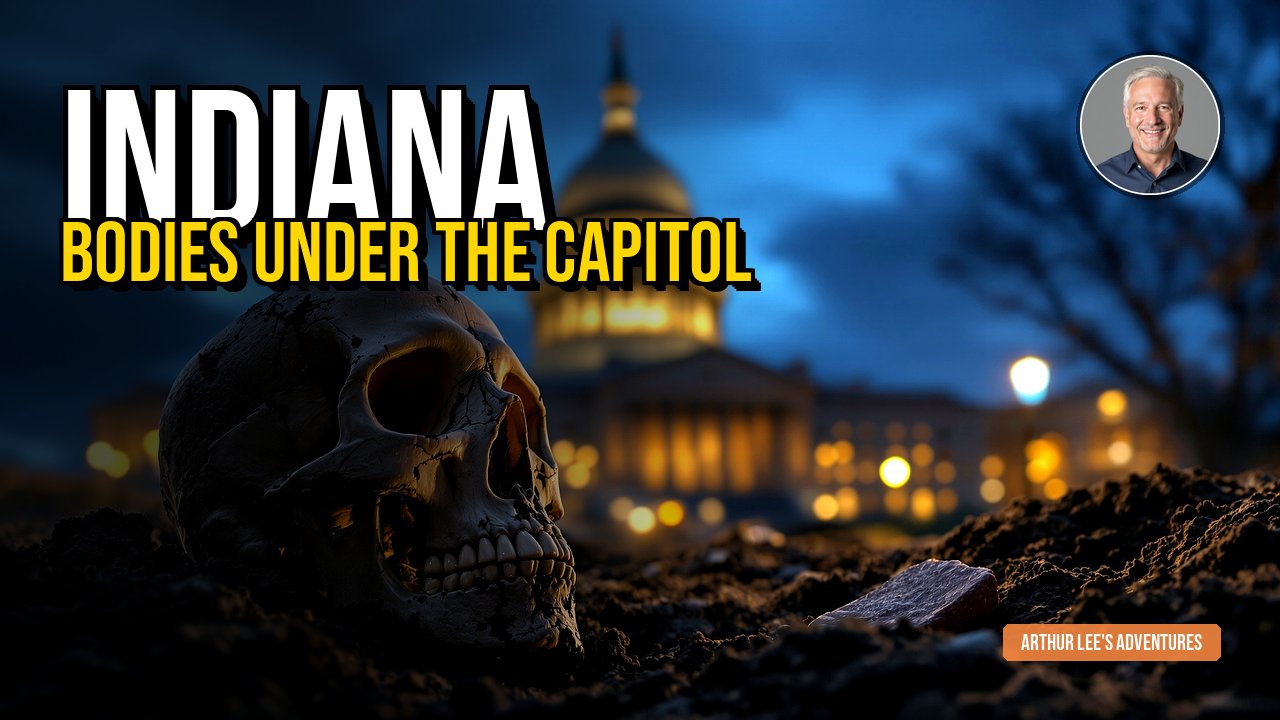
Indiana is the state people think they can summarize in a sentence: flat land, cornfields, basketball, and the Indianapolis 500. Every part of that is true, and every part of it is a distraction. Beneath the surface of the Hoosier State lies a history strange enough to stop you cold, starting, quite literally, with what lies beneath its seat of government.
The Burial Ground Under the Statehouse
In the 1880s, workers excavating the grounds around the Indiana Statehouse in Indianapolis unearthed something no one was prepared for: human remains, hundreds of them. They had cut into a burial ground left by the Mound Builders, a sophisticated pre-Columbian civilization that had lived across the eastern half of North America for thousands of years and buried their dead on that very site long before there was a statehouse, a state, or a United States.
The response, by the standards of the era, was to keep building. Some remains were removed for study; most were simply built over. The full extent of what lies beneath the capitol was never determined. It is one of the more haunting facts in American civic history: the government of Indiana conducts its business atop a graveyard it chose not to fully examine.
The Mound Builders were not a footnote. At Angel Mounds near Evansville, one of the best-preserved sites in the country, a community of perhaps 3,000 people once thrived, connected to trade networks that stretched hundreds of miles. Their earthworks were engineered with astronomical precision. Indiana’s recorded history begins in 1816; the people who shaped its land had already been there for a millennium.
The Wealthiest Self-Made Woman in America
By 1910, the wealthiest self-made woman in America was running her business out of Indianapolis. Madam C. J. Walker was born Sarah Breedlove in 1867 to formerly enslaved parents, orphaned at seven, widowed at twenty, and working as a laundress for barely a dollar a day. She built a hair-care empire aimed at Black women, trained thousands of sales agents, and turned a kitchen-table idea into a national manufacturing enterprise headquartered in Indiana.
She employed thousands, most of them Black women, and became one of the great philanthropists of her time, funding the NAACP’s anti-lynching work, scholarships, and Black institutions. When she died in 1919, her estate was worth a fortune. Indiana was the base of all of it.
When the Klan Ran the State
Indiana’s darkest modern chapter is one it rarely advertises. In the 1920s, the state had one of the largest Ku Klux Klan memberships in the entire country, not in the Deep South, but in the Midwest. At its 1924 peak, roughly thirty percent of Indiana’s native-born white men belonged. The Klan controlled the legislature, city governments, and helped elect a governor.
Its Grand Dragon, D. C. Stephenson, declared, “I am the law in Indiana.” Then, in 1925, he was convicted of the murder of a young woman named Madge Oberholtzer. When his pardon failed to materialize, he exposed the politicians the Klan had bought, and the whole machine collapsed almost overnight. It remains one of history’s sharpest lessons in how corruption can consume itself.
A City Built From Sand
Indiana also contains the full arc of American industry in a single city. In 1906, United States Steel needed land for the largest steel plant ever built. It bought an empty stretch of Lake Michigan dunes and constructed an entire city from nothing, streets, schools, and water systems laid out before anyone moved in, naming it Gary after chairman Elbert Gary. At its peak Gary held nearly 180,000 people and produced the steel that built skyscrapers and won a world war. Then imports, automation, and disinvestment hollowed it out. The plant still runs; the city that grew around it is a fraction of its former self.
The Rearview Mirror and the Town Called Santa Claus
Not all of Indiana’s secrets are heavy. There is a real town legally named Santa Claus, Indiana, whose post office answers hundreds of thousands of children’s letters every year and which opened Santa Claus Land in 1946, the first themed amusement park in America, nine years before Disneyland. And there is the Indianapolis Motor Speedway, built to test cars, which nearly killed motorsport in its first deadly season before being rebuilt with 3.2 million hand-laid bricks. When Ray Harroun won the first Indianapolis 500 in 1911, he raced alone and mounted a mirror to see behind him. Every rearview mirror on every car since traces back to that improvisation.
Why Indiana Rewards a Second Look
The through-line in all of this is that Indiana has always been a place America passes through, “the Crossroads of America,” and crossroads collect stories. A burial ground beneath the capitol, an empire built by a laundress, a state briefly captured by the Klan, a city conjured from sand, and a small mirror that changed how the world drives. The lesson of Indiana is the lesson of most “ordinary” places: the flatness is on the surface. Dig even slightly, and the ground turns out to be full of the past.