Ohio’s Hidden History: How a Burning River and Underground Railroad Shaped America
The story of Ohio reads like a compressed version of American history itself—equal parts innovation and environmental destruction, liberation and industrial exploitation. Between the 1820s and 1969, this Midwestern state became the unlikely epicenter of movements that would reshape the nation: from the Underground Railroad’s most successful operation to an environmental disaster so shocking it helped create the EPA.
The Beacon That Saved 2,000 Lives
In the river town of Ripley, Ohio, a simple lantern became one of the most powerful symbols of American freedom. The Rankin family beacon, operated by Presbyterian minister John Rankin and his family from 1825 to 1865, guided an estimated 2,000 enslaved people across the treacherous waters of the Ohio River to freedom.
John Rankin’s house, perched strategically on a bluff overlooking the Ohio River, served as both lighthouse and sanctuary. The beacon system was elegantly simple: when the coast was clear of slave catchers, a lantern would appear in the window facing Kentucky. Enslaved people waiting on the southern bank knew this signal meant safe passage awaited.
What made the Rankin operation extraordinary wasn’t just its scale—though 2,000 people represented one of the Underground Railroad’s most successful routes—but its boldness. Rankin openly challenged slavery through his writings and sermons, making himself a target for bounty hunters who regularly crossed into Ohio seeking their human quarry. Kentucky slaveholders placed a $2,500 bounty on Rankin’s head (roughly $80,000 today), yet the family continued their work for four decades.
The Rankin beacon inspired Harriet Beecher Stowe’s novel “Uncle Tom’s Cabin,” particularly the dramatic river crossing scene. Stowe visited Rankin and heard firsthand accounts of desperate midnight crossings, including the famous story of Eliza Harris, who fled across ice floes on the Ohio River carrying her infant son.
When Water Became Fire: The Cuyahoga River Disaster
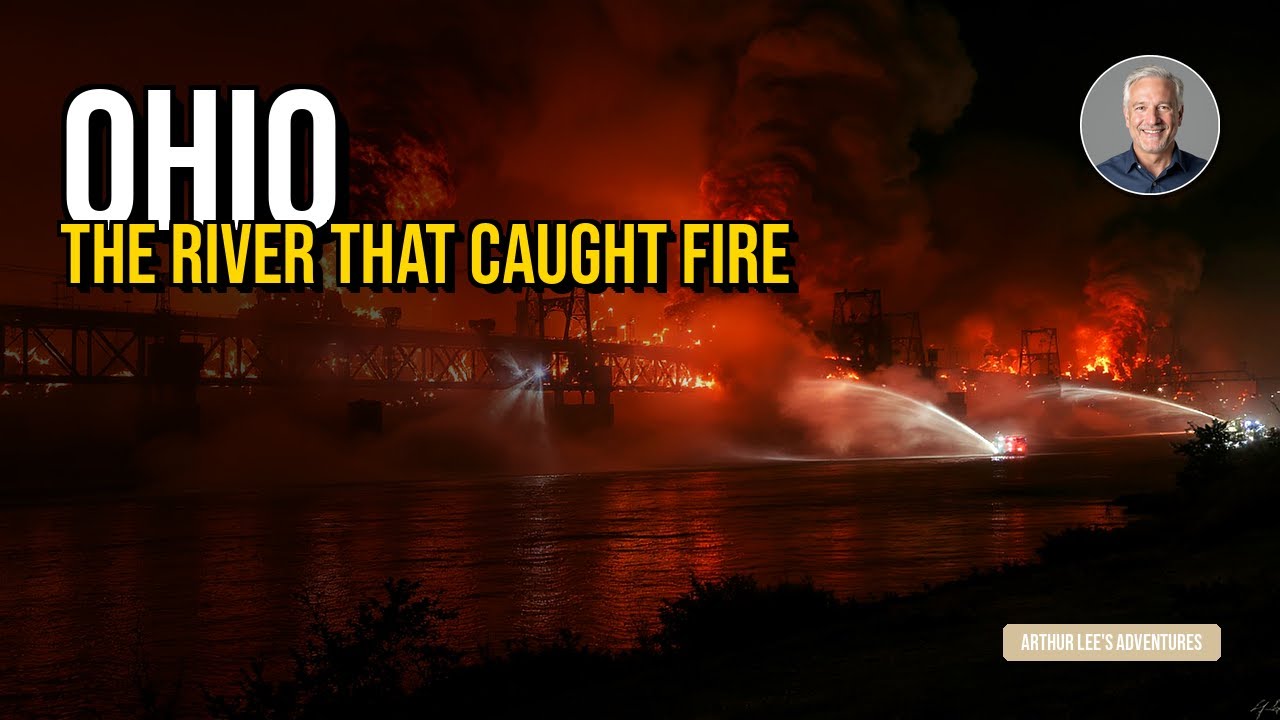
On June 22, 1969, the Cuyahoga River caught fire for at least the thirteenth time in a century. This wasn’t unusual—the river had been igniting regularly since the 1860s, fueled by oil slicks, chemical waste, and floating debris that made its surface more flammable than many solid materials.
But 1969 was different. TIME magazine’s coverage of the fire, featuring a photograph of flames towering over Cleveland’s industrial landscape, shocked Americans into confronting the environmental cost of unchecked industrial growth. The image became a symbol of American environmental degradation, though ironically, the famous photograph actually showed a more spectacular 1952 fire—the 1969 blaze lasted only about 30 minutes and caused just $50,000 in damage.
The river’s condition was genuinely apocalyptic. By the 1960s, the Cuyahoga contained no fish downstream of Cleveland. The water was so saturated with industrial chemicals that it was officially classified as a fire hazard by the city. Oil companies, steel mills, and chemical plants had treated the river as a free disposal system for over a century.
Cleveland’s mayor at the time, Carl Stokes, leveraged national outrage over the burning river to secure federal attention and funding for cleanup efforts. The disaster became a rallying cry for environmental activists and helped build public support for landmark legislation.
The environmental movement that emerged from the Cuyahoga’s flames achieved remarkable legislative success. The Clean Water Act (1972), the Clean Air Act (1970), and the creation of the Environmental Protection Agency (1970) all traced their political momentum back to that burning river in Cleveland. Within two decades, the Cuyahoga supported fish populations again—a transformation that seemed impossible in 1969.
Innovation Born from Chaos: Garrett Morgan’s Life-Saving Inventions
Cleveland in the early 20th century was a city of intersections—railroad crossings, streetcar lines, and increasingly, automobile traffic creating deadly confusion at every corner. Into this chaos stepped Garrett Morgan, an African American inventor whose traffic signal design forms the basis of every traffic light system in use today.
Morgan’s three-position traffic signal, patented in 1923, introduced the crucial “caution” phase that gave pedestrians and vehicles time to clear intersections safely. His T-shaped device could display “Stop,” “Go,” and “All Stop” positions, preventing the simultaneous green lights that had made intersections virtual death traps.
The invention emerged from Morgan’s direct observation of a horrific collision between an automobile and a horse-drawn carriage at a Cleveland intersection. Existing two-position signals created split-second timing nightmares that regularly claimed lives. Morgan’s innovation saved countless lives and established principles still used in modern traffic management.
But Morgan’s genius extended beyond traffic safety. His smoke hood invention, developed in 1916, became the prototype for modern gas masks. Morgan and his brother demonstrated the device’s effectiveness during a 1916 tunnel explosion beneath Lake Erie, where they rescued workers trapped by toxic fumes. The dramatic rescue brought national attention to Morgan’s invention, which was later adapted for use by soldiers in World War I.
Despite the life-saving potential of his inventions, Morgan faced racial discrimination that limited his business opportunities. Many customers canceled orders when they discovered the inventor was Black, forcing Morgan to hire white actors to demonstrate his products in some markets.
The Birth of Modern Monopoly: Rockefeller’s Cleveland Empire
John D. Rockefeller’s decision to base Standard Oil in Cleveland transformed both the city and American business practices forever. When Rockefeller established his refinery operation in Cleveland in 1863, he chose the location for cold-blooded strategic reasons: proximity to oil fields in Pennsylvania, access to Great Lakes shipping, and connection to multiple railroad lines that allowed him to negotiate preferential rates.
Cleveland’s location proved perfect for Rockefeller’s revolutionary business strategy. Rather than simply refining oil, he systematically acquired every aspect of the oil business—pipelines, railroads, refineries, and distribution networks. By 1882, Standard Oil controlled roughly 90% of American oil refining and distribution from its Cleveland headquarters.
Rockefeller’s methods were ruthlessly effective. He negotiated secret rebates with railroads, undercutting competitors’ shipping costs. He bought out rivals at artificially low prices after driving them to near-bankruptcy through price wars he could afford to sustain longer than smaller companies. Independent oil producers found themselves unable to get their products to market as Rockefeller controlled the transportation infrastructure.
The Standard Oil monopoly demonstrated the potential for industrial concentration on an unprecedented scale. From Cleveland, Rockefeller created the first true multinational corporation, with operations spanning the globe. The company’s efficiency and scale brought down oil prices for consumers, but its market dominance eliminated competition and concentrated enormous economic power in a single entity.
The federal government’s 1911 Supreme Court decision breaking up Standard Oil under antitrust laws established crucial precedents for regulating monopoly power. The breakup created 34 separate companies, including several that eventually became ExxonMobil, Chevron, and other major oil corporations that remain influential today.
America’s First Professional Sports Team
Cincinnati’s contribution to American culture took an unexpected form in 1869 when the Cincinnati Red Stockings became the first openly professional baseball team. Before 1869, baseball maintained the fiction of amateurism—players received under-the-table payments while officially playing for the love of the game.
The Red Stockings changed everything by openly paying salaries ranging from $600 to $1,400 per year (roughly $12,000 to $28,000 today). Team captain Harry Wright recruited the best players from across the country, creating baseball’s first true all-star team. The decision scandalized traditional baseball circles but proved enormously popular with fans.
The team’s 1869 season was legendary: 65 games without a defeat, including a transcontinental tour that brought professional baseball to the American West for the first time. Their success demonstrated that professional athletics could be both commercially viable and culturally significant.
The Red Stockings’ innovation extended beyond player salaries. They pioneered modern sports marketing, selling photographs and memorabilia to fans. Their games became major social events, attracting crowds that included prominent business leaders and politicians. The team proved that sports could serve as both entertainment and civic pride.
Their success inspired the formation of the National Association of Professional Base Ball Players in 1871, followed by the National League in 1876. The organizational structures and business models pioneered by the Cincinnati Red Stockings became the foundation for all modern professional sports.
Lessons for Modern America: Monopoly Power in the Digital Age
The parallels between Rockefeller’s Standard Oil and today’s technology giants raise fundamental questions about market concentration and democratic governance. Google controls roughly 90% of internet search—the same market share Standard Oil held in oil refining when the federal government broke it up in 1911.
Amazon dominates e-commerce infrastructure much as Standard Oil controlled oil transportation networks. Facebook’s control of social media communication resembles Standard Oil’s grip on petroleum distribution. Like Rockefeller’s empire, these companies argue that their dominance creates efficiencies that benefit consumers through lower prices and better services.
The Ohio story suggests that monopoly power inevitably intersects with broader social and political questions. Standard Oil’s influence extended far beyond oil markets into politics, labor relations, and regional economic development. Today’s technology monopolies similarly shape political discourse, labor markets, and social relationships in ways that extend far beyond their specific business functions.
Environmental degradation and corporate power often intersect, as the Cuyahoga River’s century of fires demonstrates. The same industrial concentration that enabled Standard Oil’s efficiency also created environmental disasters that required decades to remedy. Modern technology companies face similar questions about their environmental and social impact, from energy consumption in data centers to the psychological effects of social media platforms.
Ohio’s history reveals both the creative potential and destructive power of unchecked industrial development. The state that produced both Garrett Morgan’s life-saving inventions and the Cuyahoga River fires embodies America’s ongoing struggle to harness technological progress for human benefit while preventing the concentration of power that threatens democratic governance and environmental sustainability.
The Rankin family’s beacon reminds us that individual courage and moral clarity can create change even within systems of oppression. Their success in guiding 2,000 people to freedom demonstrates how local action can contribute to national transformation—a lesson particularly relevant as Americans grapple with questions of corporate power, environmental protection, and social justice that echo Ohio’s complex history.