Virginia’s Hidden History: 10 Facts They Never Taught You in School
The Commonwealth kept more secrets than most states admit. From a Nazi prison camp that became a CIA spy school to a Black landowner who beat the colonial system at its own game, Virginia’s forgotten chapters rewrite everything you thought you knew.
There is a particular kind of historical blindness that comes not from ignorance but from omission. Virginia — the state that gave America four of its first five presidents, the state where English colonization took its first trembling steps — has a habit of curating its own story. The statues get built. The textbooks get written. And certain inconvenient, complicated, genuinely astonishing chapters get quietly shelved.
What follows expands on ten of those shelved chapters, adding context and connective tissue to a story that is far stranger, far more morally complicated, and far more relevant than the sanitized version most of us learned in school.
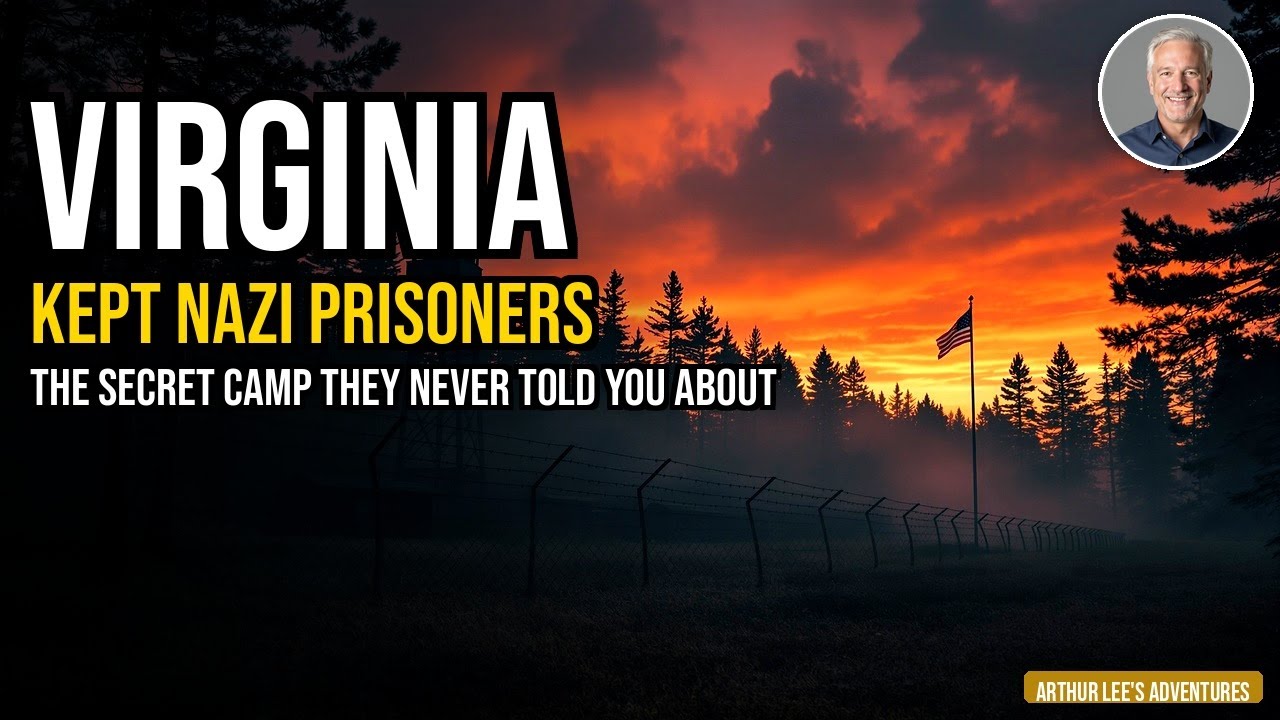
The Virginia Military Base That Held 3,000 Nazi Prisoners — Then Trained America’s Spies
Camp Peary, located in York County near Williamsburg, has had two lives. Most Americans know, if they know anything at all, that it currently operates as a CIA training facility — “The Farm,” in the agency’s internal vernacular, the place where intelligence officers learn tradecraft, surveillance, and the arts of Cold War survival.
What far fewer people know is what came before.
In 1943, as the Allied campaign in North Africa began producing massive numbers of German and Italian prisoners, the U.S. military scrambled to find places to house them. Under the Geneva Convention, POWs required humane treatment, adequate food, and shelter. Camp Peary became one of the solutions. At its peak, the facility held approximately 3,000 captured German soldiers — Wehrmacht infantry, Luftwaffe personnel, Afrika Korps veterans — just a few miles from Colonial Williamsburg, where tourists were already visiting reconstructed colonial taverns and blacksmith shops.
The proximity is almost absurdly American. Two miles from a living history museum celebrating the birth of democracy, thousands of soldiers from the Third Reich were being held behind wire.
Then the war ended. The prisoners went home. And the CIA, freshly chartered in 1947, went shopping for real estate with the right combination of isolation, existing infrastructure, and institutional secrecy. Camp Peary fit perfectly. By the early Cold War period, The Farm was training case officers who would operate across Europe, Asia, and Latin America during the most dangerous decades of the nuclear age.
Virginia residents living nearby had no meaningful access to information about either phase of the facility’s operation. The question that raises — about the government’s obligation to be transparent with the communities surrounding classified installations — remains genuinely unresolved. National security demands secrecy. Democratic accountability demands disclosure. Camp Peary sits at exactly that fault line.
The Real First Thanksgiving Was in Virginia — and It Was Mandatory
The Pilgrim story is among the most durable myths in American civic life. Plymouth Rock, 1621, grateful colonists and generous Wampanoag people sharing a harvest feast. It is a good story. It is also not the first Thanksgiving on record in what would become the United States.
That distinction belongs to Berkeley Hundred, a Virginia settlement on the James River, and to December 4, 1619 — two full years before the Plymouth celebration. A group of English settlers led by Captain John Woodlief arrived aboard the ship Margaret and were instructed by their charter to observe the day of their arrival annually as a day of thanksgiving to God.
The key word is instructed. This was not a spontaneous expression of communal gratitude. It was a legal requirement written into the settlement’s founding documents. The Berkeley Hundred charter specified: “We ordaine that the day of our ships arrival at the place assigned for plantation in the land of Virginia shall be yearly and perpetually kept holy as a day of thanksgiving to Almighty God.”
John Woodlief, the expedition’s commander, carried out the observance. The settlement itself did not survive — a 1622 Powhatan attack killed most of the colonists — which may explain why this earlier thanksgiving largely disappeared from the national memory while Plymouth’s 1621 celebration, with its more photogenic narrative of cross-cultural harmony, became the template for an American holiday.
Virginia has been making this case for decades. It is historically sound. It simply disrupts a story Americans find very comfortable.
Anthony Johnson: The Black Plantation Owner Who Won in Colonial Court
Anthony Johnson arrived in Virginia around 1621, almost certainly as an indentured servant — part of the labor system that preceded the full institutionalization of race-based chattel slavery in Virginia law. He survived the 1622 Powhatan attack that killed the Berkeley Hundred settlers. He worked off his indenture. He acquired land. He acquired cattle. He acquired, ultimately, indentured servants of his own.
By the 1650s, Anthony Johnson was a free Black man operating a 250-acre farm on Virginia’s Eastern Shore. His story is remarkable for many reasons, but the episode that crystallizes it most sharply is a 1655 court case: Johnson v. Parker.
Johnson took his neighbor, a white man named Robert Parker, to the Northampton County court, arguing that Parker was wrongfully holding one of Johnson’s indentured servants, a Black man named John Casor. The court ruled in Johnson’s favor. Johnson recovered Casor.
This was 1655. Virginia was not yet the full racial caste system it would become after Bacon’s Rebellion in 1676 and the subsequent hardening of slave codes. But it was already deeply racialized. The fact that a Black property owner could sue a white neighbor and win in a colonial Virginia court tells us something important about the contingency of history — about how the brutal system of American slavery was not inevitable but was built, decision by decision, law by law, over decades.
Anthony Johnson’s story is not a redemption narrative for colonial Virginia. It is, rather, evidence of the window that existed before it slammed shut.
The College That Spent $2 Million to Move Its Campus Rather Than Integrate
This fact requires sitting with for a moment. In the mid-twentieth century, a Virginia institution of higher education responded to integration pressure not by complying, not by fighting in court, but by literally relocating its physical campus to a new county — one that would allow it to remain segregated.
The sums involved, the logistics required, the institutional will necessary to physically move a college campus rather than admit Black students: it represents one of the more extraordinary acts of institutional resistance in civil rights history. It is also one of the least discussed, perhaps because it does not fit neatly into the binary of heroic resistance versus shameful capitulation that structures most civil rights narratives. This is something stranger — creative, determined, expensive segregation.
Virginia’s Salt Mines and the Confederate War Machine
The Confederacy ran on salt. Before refrigeration, salt was how armies preserved meat. Without it, soldiers starved or ate spoiled food. Virginia’s saltworks in Saltville, in the southwestern corner of the state, were among the most strategically vital industrial installations in the Confederacy — producing millions of pounds of salt annually for Confederate armies.
Union commanders understood this perfectly. Saltville was raided four times during the Civil War, with Union forces making the difficult journey into the Virginia mountains specifically to destroy the salt production infrastructure. The October 1864 Battle of Saltville — and its violent, racially charged aftermath, in which Confederate soldiers killed wounded Black Union soldiers from the 5th United States Colored Cavalry — represents one of the war’s uglier documented atrocities on Virginia soil.
The salt mines of southwestern Virginia fed Confederate armies in the field. Their destruction was Union strategic policy. The fact that most Civil War education focuses on the major battlefield engagements while ignoring the industrial and logistical war being fought across the Virginia mountains says something about which stories we choose to memorialize.
Eleanor Dare and Mary Draper Ingles: The Women Virginia Forgot
Two women from Virginia’s colonial and frontier periods deserve far more attention than they typically receive.
Eleanor Dare arrived on Roanoke Island in 1587 as part of the doomed Lost Colony expedition. She gave birth to Virginia Dare — the first English child born in the Americas — and then disappeared with everyone else when the settlement vanished. Eleanor Dare represents the most profound unsolved mystery in American colonial history. Her fate, and that of her infant daughter, remains genuinely unknown.
Mary Draper Ingles survived something almost equally harrowing. Captured by Shawnee raiders during a 1755 attack on Drapers Meadow in present-day Virginia, she was taken hundreds of miles into what is now Ohio and Kentucky. She escaped. She walked approximately 500 miles back through the wilderness in late autumn, surviving on near-starvation rations, and made it home. Her journey — undertaken without a map, without a guide, largely without adequate clothing for a Virginia winter — ranks among the more extraordinary feats of individual endurance in colonial American history.
Both women are occasionally mentioned in specialized histories. Neither has achieved the cultural prominence their stories warrant.
Why Virginia’s Hidden History Matters Now
The through-line connecting these disparate stories is not merely that they are interesting — though they are — but that they reveal the gap between the history a society chooses to tell itself and the history that actually happened.
Camp Peary moving from Nazi prison camp to CIA training ground without public disclosure reflects ongoing questions about surveillance, government transparency, and what citizens are entitled to know about facilities in their communities — questions that are, if anything, more urgent in an age of domestic intelligence operations and expanded executive secrecy.
Anthony Johnson’s victory in colonial court, followed by the subsequent hardening of Virginia’s slave codes, illustrates how racial hierarchy was constructed rather than natural — which matters enormously for understanding how such systems can be dismantled.
The college that moved its campus to avoid integration is a case study in institutional resistance, in how organizations deploy resources to preserve existing power arrangements. That pattern did not end in the 1950s.
Virginia is not unusual in having hidden histories. Every state does. What makes Virginia’s version particularly significant is the state’s outsized role in American founding mythology — the cradle of presidents, the birthplace of the Constitution’s principal authors. When Virginia’s hidden history is this different from its official history, it suggests that the gap between American mythology and American reality is wider than most civics classes acknowledge.
That gap is worth examining. These ten facts are a reasonable place to start.
This article accompanies the documentary episode “Virginia’s Hidden History: 10 Facts They Never Taught You,” covering the period from 1619 to 1974. Primary historical events discussed include the founding of Berkeley Hundred (1619), the Anthony Johnson court case (1655), the Saltville saltworks raids (1861–1864), the Mary Draper Ingles captivity (1755), and Camp Peary’s dual history as a WWII POW facility and CIA training ground.