Centralia, Pennsylvania: The Town That Has Been Burning Underground Since 1962
There is a peculiar kind of erasure that happens slowly enough that most people never notice it. A family moves away. Then another. A school closes. A post office shuts its doors. The zip code — 17927 — gets officially revoked by the United States Postal Service, which is the bureaucratic equivalent of a death certificate for a municipality. Roads buckle and crack and get condemned and eventually closed. And somewhere beneath all of it, invisible and relentless, a coal seam fire keeps burning.
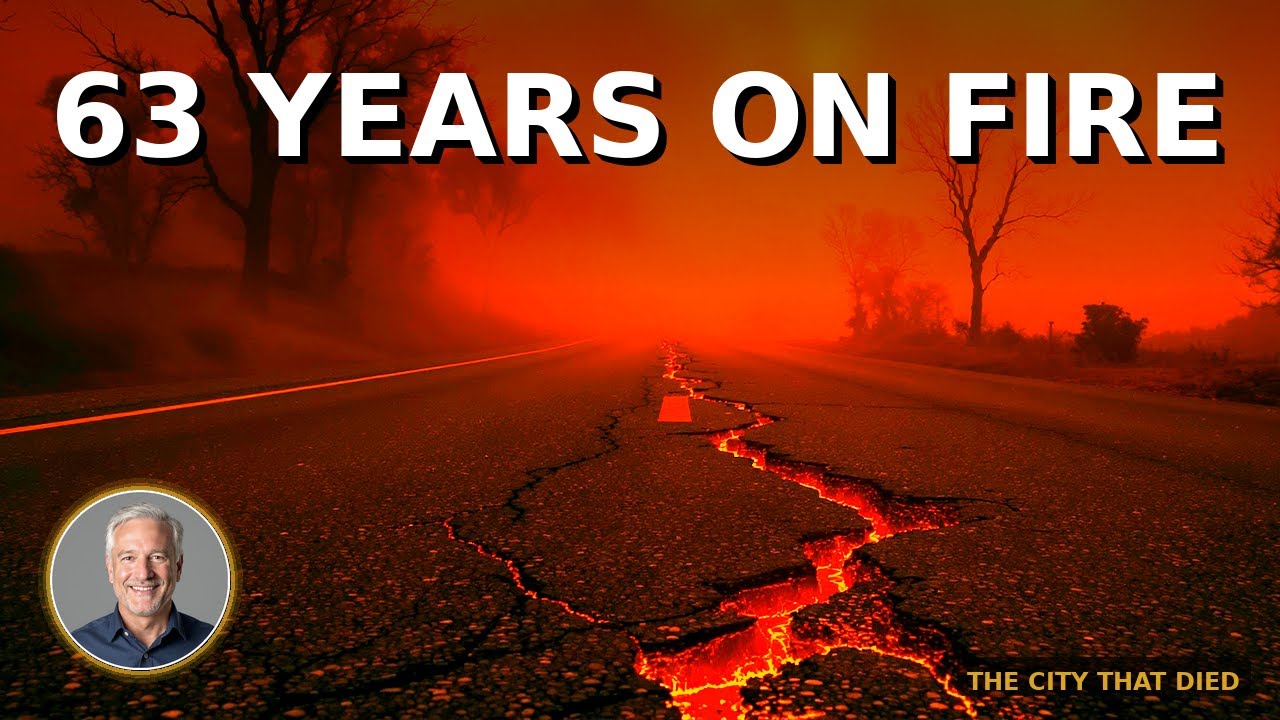
Centralia, Pennsylvania has been dying for more than six decades. It was once a town of roughly 1,000 residents, a working-class community built on the anthracite coal that runs beneath much of Columbia County. Today, fewer than ten people remain. The borough still technically exists as a legal entity. The streets are still there, mostly, though nature has begun reclaiming them. And the fire — the fire that started in 1962 and has never been fully extinguished — is still burning somewhere beneath the surface, advancing through abandoned mine shafts at a rate that experts have estimated could sustain it for another 250 years.
This is not a story about a natural disaster that struck without warning. It is a story about decisions — made by local officials, state agencies, the federal government, and individual residents — that compounded over decades into one of the most unusual environmental catastrophes in American history.
How Centralia Was Built, and What It Was Built On
To understand what happened to Centralia, you have to understand what Centralia was.
The region that would become Columbia County, Pennsylvania was recognized as coal country almost as soon as European settlers began mapping it seriously in the early nineteenth century. Anthracite coal — harder, hotter-burning, and more energy-dense than the bituminous coal found further west — ran in thick seams beneath the hills of northeastern Pennsylvania, and the extraction of that coal defined the region’s economy and culture for generations.
Centralia itself was incorporated in 1866, during the peak of the anthracite boom. By the late 1800s and into the early twentieth century, the town was a functioning, if modest, industrial community. Mines operated beneath and around the town. The population fluctuated with the fortunes of the coal industry — peaking at around 2,700 residents in 1890 before beginning a long, slow decline as mines were exhausted and the national energy economy shifted.
By 1962, Centralia had roughly 1,000 residents. The mines were largely played out. But the infrastructure of mining — the shafts, the tunnels, the culm banks where waste coal was deposited — remained beneath and around the town. That infrastructure would become the mechanism of the town’s destruction.
The Fire That Started Everything: May 27, 1962
The precise origin of the Centralia mine fire has been debated for decades, and the honest answer is that no one is entirely certain how it started. The most widely accepted account is that on or around May 27, 1962, a fire was set in the Centralia landfill — a former strip mine pit on the edge of town — as part of a routine trash-burning operation that the borough conducted periodically to manage refuse. It was a common practice at the time, and not considered unusual.
What was unusual — catastrophically so — was that the burning trash ignited an exposed coal seam at the base of the pit. The fire moved into the abandoned mine workings beneath Centralia. And once inside that network of tunnels, it had virtually unlimited fuel and enough oxygen to sustain itself indefinitely.
Early remediation efforts were attempted and proved inadequate. Trenches were dug. Holes were drilled. Slurry was pumped in. But the mine fire had too many pathways, too much coal to consume, and the geography of the underground workings made comprehensive suppression essentially impossible without a massive, coordinated excavation effort that would have cost tens of millions of dollars in the 1960s and required the effective demolition of significant portions of the town above.
The fire was allowed to smolder.
The Ground Opens: Todd Domboski and the Moment That Changed Everything
For nearly two decades, the fire burned without producing a moment dramatic enough to force a national reckoning. There were complaints from residents about carbon monoxide seeping into basements. There were readings from monitoring equipment that showed dangerous gas levels in certain areas. But the fire was invisible, and invisible disasters are easy to defer.
That changed on February 14, 1981.
Todd Domboski was twelve years old. He was walking through his grandmother’s backyard in Centralia when the ground gave way beneath him. The sinkhole that opened was approximately four feet wide and 150 feet deep — a near-vertical shaft into the burning earth below, filled with superheated steam and carbon monoxide gas at concentrations that would have been lethal within minutes.
Domboski managed to grab the edge of the hole as he fell. His fourteen-year-old cousin, Eric Wolfgang, was nearby and grabbed his arms, pulling him back to the surface.
The incident was covered nationally. It produced the kind of visceral, specific image — a child, a hole, 150 feet of burning darkness — that abstract environmental data cannot. Public pressure for action increased substantially in the months that followed.
The Government Response: Millions Spent, and Then Surrender
Federal involvement in the Centralia situation escalated significantly in the early 1980s. The Office of Surface Mining, the state of Pennsylvania, and eventually Congress all became engaged with the question of what to do about a town sitting over an uncontrollable underground fire.
In 1983, Congress appropriated $42 million for a voluntary relocation program. Most Centralia residents — a significant majority — accepted the buyout offers and left. Their homes were demolished. The lots were cleared. Streets that had once been lined with houses became open fields.
Key figures in the community navigated this period in different ways. David Lamb, a local official who had been engaged with the fire issue for years, worked to communicate the scope of the problem to state and federal authorities. John Coddington and Thomas Larkin were among the residents who engaged directly with the relocation process, representing different perspectives on what the community owed its members and what the government owed the town.
By the early 1990s, the voluntary program had largely run its course. Most residents had left. But a small number refused.
Eminent Domain and the Right to Stay
In 1992, Pennsylvania Governor Robert Casey invoked eminent domain over all properties in Centralia, legally compelling the remaining residents to leave. Most complied. A small group did not, and they sued.
The legal battle was prolonged and, in its way, philosophically significant. The remaining residents — people who had lived their entire lives in Centralia, whose families were buried in the local cemetery, who had built their identities around this specific place — argued that the government’s power to displace them for their own safety had limits. That a person’s home is not simply an asset to be compensated and seized. That belonging to a place is not the same as owning property in it.
The courts did not ultimately agree, but the Commonwealth of Pennsylvania reached a compromise of sorts: the remaining residents could stay for the duration of their natural lives, after which their properties would revert to the state. It was an arrangement that acknowledged something real about the situation — that for the people still living there, relocation was not simply a practical matter but an existential one.
As of this writing, fewer than ten people remain in Centralia. They live among the ruins of a town that has been largely unmade around them.
What the Fire Means Now
The Centralia mine fire is often discussed as an anomaly — a freak accident, a unique convergence of geological circumstance and bureaucratic failure. And in its specifics, it is unusual. But the broader pattern it represents is not.
Across Appalachia and the broader American coal country, there are more than 200 known mine fires burning underground, according to estimates from the Office of Surface Mining Reclamation and Enforcement. Most of them are small. None has produced a situation quite like Centralia. But they represent a category of problem that industrialized coal extraction left behind — a legacy cost that the industry itself never paid and that communities and governments have been absorbing in various ways ever since.
The Centralia situation also sits within a longer American conversation about what government owes its citizens when industrial development — often encouraged, subsidized, and regulated by that same government — produces environmental harm. The anthracite coal industry that built Centralia operated with the full knowledge and participation of state and federal authorities for generations. The infrastructure of abandoned mines that allowed the fire to spread was a direct product of that industry. And yet the cost of the disaster fell most heavily on the people who happened to live above it.
The legal and ethical questions raised by the eminent domain proceedings in Centralia have not been resolved by the Centralia case. They recur in contaminated communities across the country — in places where residents are asked to leave homes they love for reasons that are not their fault, and to accept a check as sufficient compensation for everything they are losing.
Whether the government was right to ultimately compel relocation — or whether those who refused had a legitimate claim to stay in their homes regardless of the risk — is a question that does not have a clean answer. It is the kind of question that depends entirely on what you believe government is for, and what you believe a home means.
The fire does not have an opinion on the matter. It just keeps burning.