The Rise and Fall of Fordlandia: When American Industrial Ambition Met the Amazon Rainforest
Deep in the Brazilian Amazon, along the muddy banks of the Tapajos River, stand the crumbling remnants of one of the 20th century’s most audacious industrial experiments. Fordlandia, Henry Ford’s ambitious attempt to create an American-style company town in the heart of the rainforest, represents a fascinating collision between industrial hubris and natural reality that still offers lessons nearly a century later.
The Vision That Never Left Detroit
In 1928, at the height of his industrial empire, Henry Ford faced a pressing problem. The British and Dutch controlled most of the world’s rubber plantations in Southeast Asia, and Ford’s automobile assembly lines desperately needed a reliable, cost-effective rubber supply. The solution, Ford believed, lay in Brazil’s Amazon basin—the original home of the rubber tree.
Ford’s vision extended far beyond mere rubber cultivation. He imagined transplanting American industrial efficiency and moral values to the tropics, creating a model community that would demonstrate the superiority of American capitalism and culture. The result was Fordlandia, a 2.5-million-acre concession along the Tapajos River in the state of Pará, Brazil.
The project’s scope was staggering. Ford invested over $20 million (equivalent to roughly $300 million today) in infrastructure, equipment, and personnel. He dispatched teams of American managers and engineers to carve a modern industrial town from virgin rainforest, complete with hospitals, schools, recreational facilities, and neat rows of suburban-style houses that wouldn’t have looked out of place in Dearborn, Michigan.
When American Efficiency Meets Amazonian Reality
The first signs of trouble emerged almost immediately. Einar Oxholm, one of Ford’s initial project managers, arrived to find that the Brazilian government had granted Ford land that was largely unsuitable for large-scale rubber cultivation. The terrain was hilly and difficult to clear, quite different from the flat, easily managed plantations of Southeast Asia.
More fundamentally, Ford’s team had failed to consult botanists or tropical agriculture experts before launching the project. They planted rubber trees in neat, orderly rows—an approach that looked efficient but created perfect conditions for leaf blight and other diseases that thrive when host plants are concentrated together. In nature, rubber trees grow scattered throughout the diverse Amazon ecosystem, making it difficult for specialized pests and diseases to spread.
Archibald Johnston, who served as one of Fordlandia’s later managers, documented the escalating agricultural failures. The carefully planted rubber groves suffered repeated devastation from leaf blight, caterpillars, and other pests. By 1933, it became clear that the plantation would never produce rubber in commercially viable quantities.
Cultural Imperialism in the Jungle
Perhaps even more problematic than the agricultural challenges were Ford’s attempts to impose American social norms on Brazilian workers. Ford, a teetotaler and strict moralist, banned alcohol throughout Fordlandia—a particularly unpopular policy in a region where cachaça (Brazilian rum) was deeply embedded in local culture.
The company cafeteria served only American food: hamburgers, canned peaches, and oatmeal, much of it imported at enormous expense. Brazilian workers, accustomed to rice, beans, and local fish, found the foreign diet unappetizing and often indigestible. Evening entertainment consisted of mandatory square dancing lessons and poetry readings—activities that held little appeal for workers who preferred their traditional music and storytelling.
James Weir, who served as a technical advisor to the project, later wrote about the cultural disconnect between American managers and Brazilian employees. The Americans lived in screened houses with electric fans and imported furniture, while Brazilian workers were housed in barracks-style accommodations. This segregation bred resentment and highlighted the colonial nature of the enterprise.
The Revolt of December 1930
The simmering tensions between American management and Brazilian workers erupted spectacularly in December 1930. What began as complaints about food quality in the company cafeteria quickly escalated into a full-scale uprising.
Brazilian workers, frustrated by months of cultural insensitivity and poor working conditions, launched a coordinated revolt. They smashed expensive equipment, overturned company vehicles, and chased American managers into the jungle with machetes. The rebellion was so fierce that several American supervisors had to hide in the forest for days before being evacuated by boat.
The revolt represented more than simple labor unrest—it was a rejection of Ford’s paternalistic vision of American cultural superiority. The Brazilian workers weren’t merely objecting to poor wages or working conditions; they were asserting their right to maintain their own cultural identity and traditions.
The Absentee Visionary
Perhaps the most telling detail about Fordlandia is that Henry Ford himself never visited the project. Not once during its seventeen-year existence did the man who conceived and financed this massive undertaking set foot in the Amazon. This absence speaks volumes about the project’s fundamental disconnect from local realities.
Ford’s decision to remain in Detroit while attempting to manage a complex tropical agricultural and social experiment from thousands of miles away exemplified the kind of colonial thinking that doomed the project from its inception. He relied on reports from subordinates who often told him what they thought he wanted to hear, rather than the difficult truths about the project’s mounting problems.
The Final Accounting
By 1945, with World War II ending and synthetic rubber technology advancing rapidly, Ford finally acknowledged defeat. He sold Fordlandia back to the Brazilian government for just $244,200—a fraction of his massive investment. The project had produced virtually no rubber and had become a source of embarrassment for the Ford Motor Company.
The human cost was equally significant. Hundreds of workers had suffered from malaria, yellow fever, and other tropical diseases. The environmental impact of clearing thousands of acres of pristine rainforest for failed agricultural experiments would take decades to heal.
Echoes of Empire: Fordlandia’s Modern Relevance
Fordlandia’s failure offers enduring lessons about the dangers of cultural imperialism and environmental ignorance in an era of increasing globalization. The project’s collapse foreshadowed many subsequent development disasters in the Amazon and other tropical regions, where outside interests imposed inappropriate technologies and social systems on complex local ecosystems.
The story resonates particularly strongly today as multinational corporations continue to struggle with sustainable development in emerging markets. Fordlandia stands as a cautionary tale about the importance of local knowledge, cultural sensitivity, and environmental understanding in international business ventures.
Moreover, the project’s environmental failures—particularly Ford’s ignorance of biodiversity’s role in preventing plant diseases—highlight principles that remain crucial for sustainable agriculture. Modern monoculture farming still faces many of the same pest and disease problems that destroyed Ford’s rubber plantations.
The Jungle’s Victory
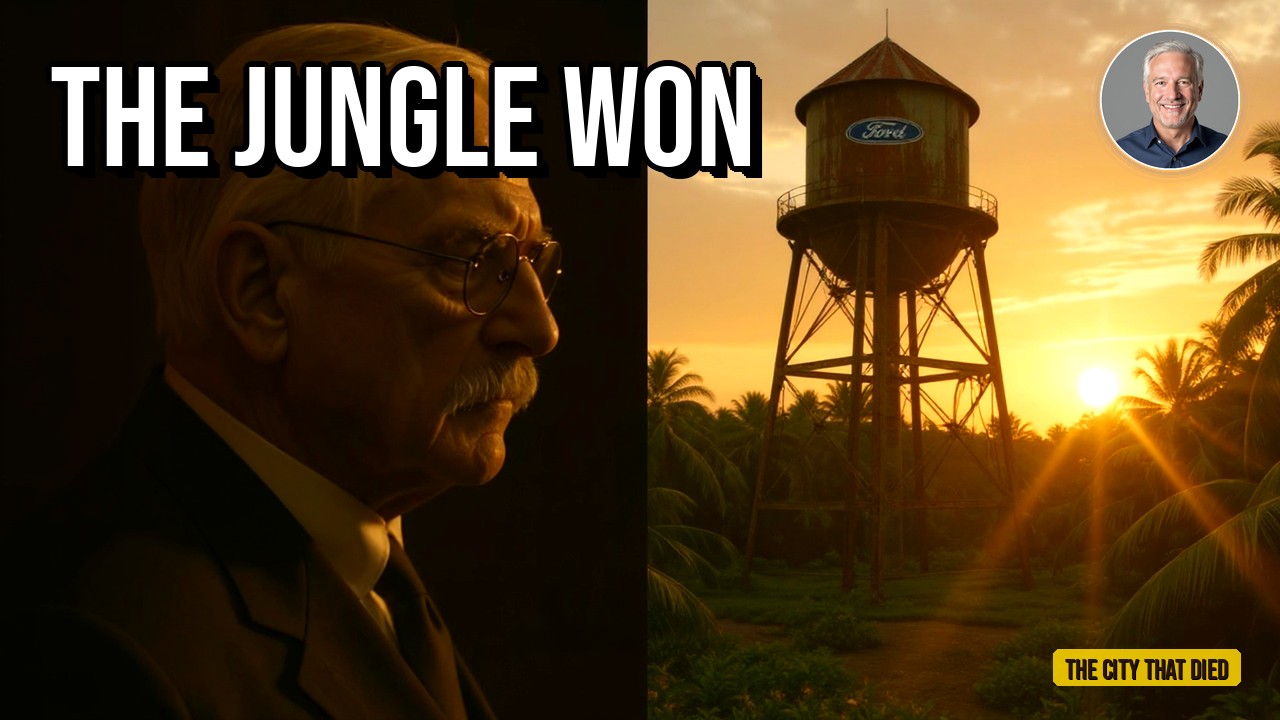
Today, vines and trees have reclaimed much of Fordlandia. The hospital still stands, along with some of the American-style houses, but they serve as monuments to hubris rather than progress. Local communities have developed around the ruins, creating a hybrid culture that incorporates some American influences while maintaining strong Brazilian roots.
The jungle’s victory over Ford’s industrial vision was not simply a triumph of nature over technology, but of local knowledge over imposed expertise, of cultural authenticity over manufactured identity, and of environmental complexity over industrial simplification. In the end, Fordlandia’s greatest lesson may be that true success in any environment—business, social, or ecological—requires deep understanding and genuine respect for local conditions rather than the blind application of external models, no matter how successful they may have been elsewhere.