The Rise and Fall of Gary, Indiana: America’s Greatest Company Town Experiment
In the summer of 1906, Elbert Henry Gary stood on windswept sand dunes beside Lake Michigan and envisioned something unprecedented: an entire industrial city built from nothing. Within 905 days, those empty dunes would become Gary, Indiana—a gleaming metropolis of steel mills, tree-lined boulevards, and the promise of American prosperity. By 1960, 178,000 people called it home, including a musical family named Jackson whose youngest son would become the King of Pop.
Today, abandoned churches pierce the skyline with trees growing through their roofs, and only 69,000 residents remain in a city built for three times that number. The story of Gary, Indiana, represents both the pinnacle of American industrial ambition and its most spectacular collapse—a cautionary tale that echoes across every Rust Belt city from Detroit to Pittsburgh.
The 905-Day Miracle: Building America’s Steel Capital
When U.S. Steel Corporation purchased 9,000 acres of Lake Michigan shoreline in 1906, the location seemed almost absurd. The Indiana Dunes were nothing but shifting sand, sparse vegetation, and a handful of struggling settlements. But Elbert Henry Gary, the company’s chairman, saw strategic brilliance: direct access to Lake Michigan for shipping iron ore from Minnesota, proximity to Pennsylvania coal via railroad, and cheap land far from Chicago’s expensive real estate.
The construction of Gary represented the largest private urban development project in American history. U.S. Steel didn’t just build a factory—they engineered an entire civilization. The Gary Works steel mill stretched for miles along the lakefront, while the company simultaneously constructed roads, sewage systems, schools, hospitals, and housing for thousands of workers.
The speed was breathtaking. By 1909, Gary Works was operational, Gary City Hall opened its doors, and the first residents were moving into company-built neighborhoods. The city was incorporated with a population of 16,802—all of it built on empty sand dunes in less than three years.
The Golden Age: When Gary Led America
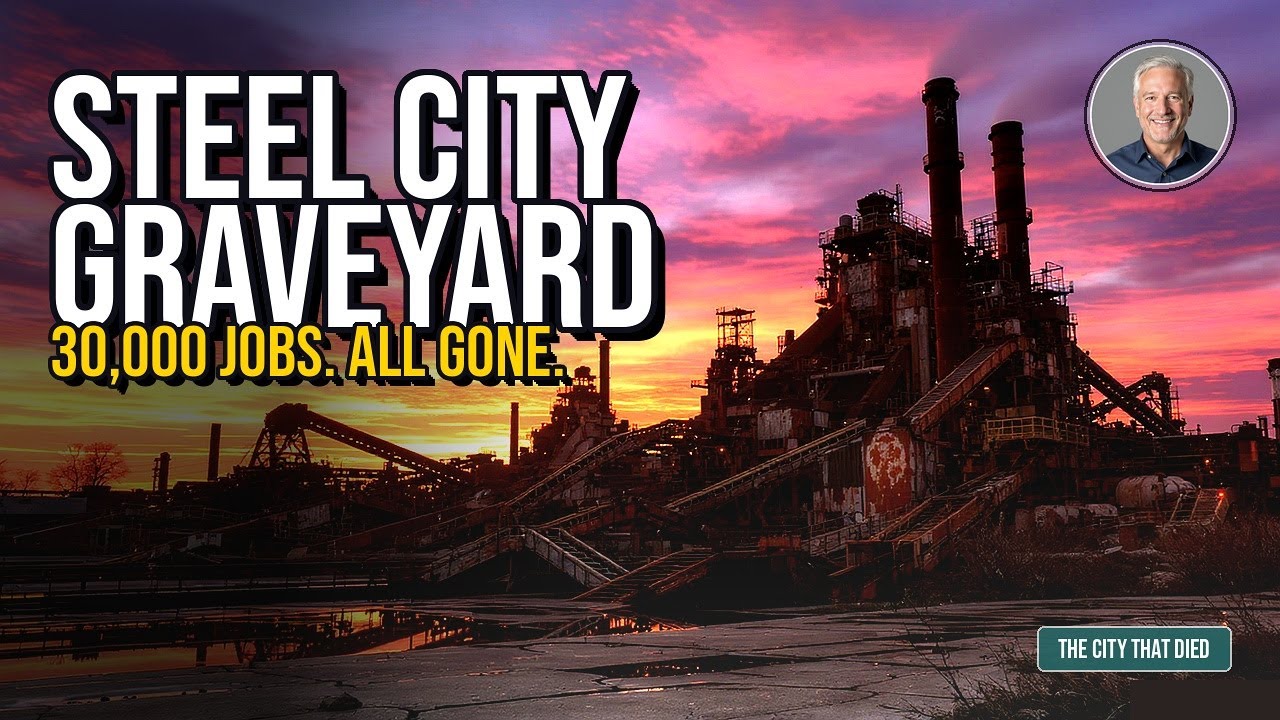
Between 1910 and 1960, Gary, Indiana, became synonymous with American industrial might. The Gary Works grew into the largest steel mill complex in the world, stretching seven miles along Lake Michigan and employing over 30,000 workers at its peak. The facility produced steel for skyscrapers, automobiles, and two world wars.
The prosperity was extraordinary. By 1960, Gary residents enjoyed the highest per capita income in Indiana. Broadway buzzed with department stores, restaurants, and the magnificent Palace Theatre, which hosted touring Broadway shows and major entertainers. City Methodist Church, completed in 1926 at a cost of $1 million, seated 3,500 congregants and featured a 100-foot Gothic tower that dominated the skyline.
This was also the era when Gary’s most famous residents were growing up. At 2300 Jackson Street, Joe and Katherine Jackson raised their nine children in a modest two-bedroom house. Their sons—Jackie, Tito, Jermaine, Marlon, and Michael—would practice in the living room before becoming the Jackson 5, putting Gary on the global entertainment map.
The city’s success attracted waves of migration. During the Great Migration, thousands of African American families moved north from the South seeking factory jobs and better lives. By 1960, Gary had become one of America’s most integrated industrial cities, with thriving Black-owned businesses along Broadway and strong labor unions providing middle-class wages regardless of race.
The Collapse Begins: Foreign Steel and White Flight
The warning signs appeared in the 1960s, though few recognized them at the time. Foreign steel producers, particularly from Japan and Germany, began undercutting American prices with more efficient production methods. U.S. Steel’s Gary Works, built for an earlier era, struggled to compete with newer facilities overseas.
The social fabric began unraveling simultaneously. Despite economic integration, Gary remained largely segregated by neighborhood. When Richard Hatcher was elected as one of America’s first Black mayors in 1967, white flight accelerated dramatically. Between 1960 and 1970, Gary’s white population dropped from 113,000 to 62,000, while the total population declined for the first time since the city’s founding.
The economic devastation followed quickly. Between 1970 and 1987, Gary Works employment collapsed from 30,000 to just 6,000 workers—a loss of 24,000 jobs in seventeen years. Each steel job supported an estimated three additional service jobs, meaning the ripple effects eliminated nearly 100,000 positions from the local economy.
Urban Decay: When Churches Become Forests
By the 1990s, Gary had become America’s symbol of urban decay. The statistics were staggering: the population had fallen from 178,000 in 1960 to under 80,000 by 2000. Entire neighborhoods stood empty, their residents fled to suburbs or other cities entirely.
Nothing symbolized the collapse more powerfully than City Methodist Church. The Gothic masterpiece that once hosted 3,500 worshippers held its final service in 1997. Within years, the roof collapsed, windows shattered, and nature began reclaiming the structure. Today, trees grow through the sanctuary floor, their branches reaching toward the sky through the broken roof—a haunting monument to a city’s lost dreams.
The Palace Theatre closed in 1972. Broadway’s department stores shuttered one by one. Entire city blocks were demolished, leaving gaps like missing teeth in what had once been a thriving downtown. The Gary that Michael Jackson sang about in “Dancing Machine”—a place of dreams and possibility—had become synonymous with American industrial decline.
Attempts at Revival: Karen Freeman-Wilson’s Legacy
Not everyone gave up on Gary. When Karen Freeman-Wilson became mayor in 2012, she inherited a city with a $23 million budget deficit and 13,000 abandoned properties. Her administration focused on “rightsizing”—demolishing beyond-repair structures while preserving salvageable neighborhoods.
Freeman-Wilson’s eight-year tenure saw modest improvements: the budget was balanced, some neighborhoods stabilized, and new investments attracted to the lakefront. The Hard Rock Casino opened in 2021, bringing jobs and tax revenue. Urban farmers began cultivating empty lots, turning symbols of decay into productive green spaces.
Yet the fundamental challenge remained: how do you rebuild a city designed for 180,000 people when only 69,000 remain? The infrastructure—roads, sewers, electrical grids—was built for triple the current population, making basic services prohibitively expensive per resident.
The Broader Lesson: Company Towns and American Deindustrialization
Gary’s story extends far beyond one city’s boundaries. It represents the vulnerability of single-industry communities across America. When U.S. Steel built Gary in 1906, the company town model seemed like enlightened capitalism—providing workers with steady employment, quality housing, and community institutions.
The fatal flaw was dependence. Unlike diversified cities that could weather the decline of individual industries, Gary lived and died with steel production. When global competition made American steel uncompetitive, Gary had no economic foundation to fall back on.
This pattern repeated across the Rust Belt: Flint, Michigan (automobiles), Youngstown, Ohio (steel), and Camden, New Jersey (manufacturing) all followed similar trajectories. Cities that seemed permanent proved surprisingly fragile when their economic foundation eroded.
Modern Relevance: Lessons for Today’s America
Gary’s rise and fall offers crucial insights for contemporary urban policy. The city’s experience demonstrates both the power and peril of rapid economic development based on single industries. Today’s boom towns—from North Dakota oil fields to Silicon Valley tech centers—might consider Gary’s cautionary tale.
The environmental costs also linger. A century of steel production left Gary with extensive soil and water contamination that complicates redevelopment efforts. Cleanup costs run into billions of dollars, highlighting how industrial prosperity can leave expensive legacies for future generations.
Yet Gary’s story isn’t finished. The city’s location—30 miles from Chicago with Lake Michigan access—remains valuable. Wind farms now operate on former industrial sites. Urban agriculture thrives in abandoned lots. Some residents argue that a smaller, sustainable Gary might emerge from the ruins of the industrial city.
Michael Jackson, who left Gary for California as a child, returned periodically throughout his life to visit family and support community initiatives. His success proved that Gary could still produce greatness, even as the city itself struggled. Perhaps that’s the ultimate lesson: cities, like people, can reinvent themselves—but only if they’re willing to acknowledge what they’ve lost and build something genuinely new from what remains.
The 905 days that built Gary, Indiana, created one of America’s most dramatic urban experiments. The 50 years of decline that followed revealed the fragility of that achievement. What happens next will determine whether Gary becomes a permanent symbol of American industrial decline—or proof that even the most damaged cities can find new life.