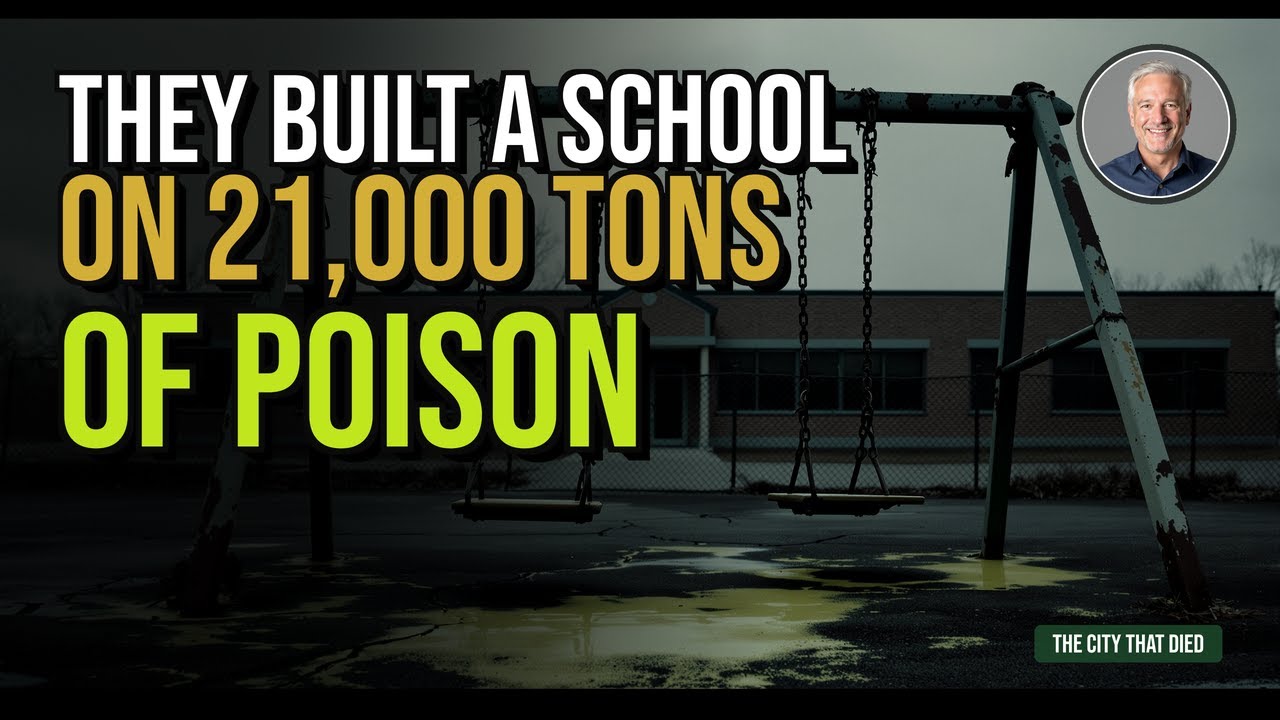
Love Canal: How a Chemical Company Buried 21,000 Tons of Poison Beneath an Elementary School — And Put the Warning in Writing
In 1953, Hooker Chemical Company sold a patch of land in Niagara Falls, New York, to the local school board for one dollar. The deed of sale contained an explicit written warning: the land held buried chemical waste, and anyone who built on it did so at their own risk. The school board read that deed, accepted that dollar, and broke ground on the 99th Street Elementary School anyway.
In September 1955, four hundred children walked through the front doors. Nobody told their parents what was twelve feet below the playground.
What followed over the next twenty-five years is one of the most consequential environmental disasters in American history — not just because of the contamination itself, but because of what ordinary people did about it. Love Canal didn’t just poison a neighborhood. It permanently changed the relationship between American citizens and the chemical industry, reshaped federal environmental law, and produced one of the most unlikely activists of the twentieth century: a twenty-seven-year-old housewife named Lois Gibbs who had never attended a public meeting in her life.
William Love’s Abandoned Dream
The story begins, as so many American disasters do, with someone’s optimistic scheme.
In 1894, a entrepreneur named William Love proposed a model industrial city near Niagara Falls. His plan centered on a canal that would connect the upper and lower portions of the Niagara River, harnessing the region’s hydroelectric potential to power the factories of his planned utopia. He broke ground, dug approximately a mile of the canal to a width of roughly 60 yards, and then watched his project collapse when the economic panic of 1893 wiped out his investors.
Love walked away. The canal sat there — an open, water-filled trench going nowhere, used intermittently for swimming until the 1920s. In 1942, Hooker Chemical and Plastics Corporation acquired the site and recognized it for what it was: a convenient, clay-lined trench in which to dispose of industrial chemical waste.
Over the next eleven years, Hooker used Love Canal as a dump for approximately 21,000 tons of chemical waste — 82 distinct chemical compounds, including pesticides, chlorinated hydrocarbons, and dioxins. The clay lining of the canal, Hooker maintained, would prevent the chemicals from migrating into surrounding soil and groundwater.
In 1952, Hooker declared the site full.
The Dollar That Was Supposed to Be a Shield
By the early 1950s, Niagara Falls was growing fast, and the school board needed land. They identified the Love Canal site — a flat, open piece of property that sat, conveniently, near a developing residential neighborhood. They approached Hooker Chemical and asked to buy it.
What happened next is where the moral complexity becomes genuinely difficult to untangle.
Hooker was reluctant. Company records suggest that executives understood the site was dangerous and did not want liability for whatever might happen if someone built on it. But the school board was persistent, and there was pressure — the kind of quiet, civic pressure that operates in mid-century company towns — to cooperate.
The solution Hooker’s lawyers devised was the one-dollar sale. For a single dollar, Hooker would transfer the land. In exchange, the deed would contain explicit language warning that the property held buried chemical waste and that Hooker bore no responsibility for any injury or damage that might result from that waste. The language was not buried in fine print. It was substantive. It was a warning.
The school board signed. The dollar changed hands. Ground was broken.
Here is the thing that makes this particular detail so difficult to let go of: Hooker knew. They knew what was in the ground, they knew it was dangerous, and their response was not to refuse the sale but to construct a legal document designed to transfer liability to an institution that was about to build a school for children. The warning in the deed was not an act of conscience. It was a legal maneuver.
Whether it worked — morally, not just legally — is a question worth sitting with.
What Was Actually in the Ground
The 82 compounds buried beneath Love Canal were not abstract. They had names, and those names had consequences.
Benzene hexachloride. Chlorobenzenes. Trichloroethylene. Lindane. And most significantly: dioxins, specifically TCDD, one of the most toxic synthetic compounds ever produced. Dioxins accumulate in fatty tissue, persist in the environment for decades, and are associated with a range of serious health outcomes including cancer, immune system disruption, and reproductive harm.
Many of the compounds buried at Love Canal were byproducts of pesticide and plastics manufacturing — the industrial residue of the post-war chemical boom that had made companies like Hooker enormously profitable.
Through the late 1950s and 1960s, as the neighborhood around the old canal filled with working-class families, the chemical stew beneath them began to move. Heavy rains and snowmelt raised the water table. The clay containment that Hooker had relied upon proved permeable under sustained hydraulic pressure. Chemicals migrated into basement walls. They seeped into sump pumps. They surfaced in backyards as oily residue after rainstorms. Children playing in the neighborhood sometimes came home with chemical burns on their hands and feet.
For years, this was filed away as neighborhood oddity — bad smells, discolored puddles, gardens that wouldn’t grow. Nobody connected it to anything systematic.
Lois Gibbs and the Education of an Activist
In 1978, a young woman named Lois Gibbs was trying to understand why her son Michael kept getting sick. He had epilepsy, a compromised immune system, and a liver disorder. He was five years old and attended the 99th Street Elementary School.
Gibbs read a series of investigative articles by journalist Michael Brown, published in the Niagara Gazette, which reported for the first time that the school neighborhood sat atop a massive chemical dump. She went to the school board and asked to have her son transferred to a different school. They said no.
So she started knocking on doors.
Gibbs has described herself, in the years before Love Canal, as someone who was afraid to speak to more than three people at once. She was not a scientist, not a lawyer, not a politician. She was a housewife in a working-class neighborhood who had read a newspaper article and decided to find out whether her neighbors’ children were sick too.
They were. Working with researcher Beverly Paigen, a biologist at Roswell Park Cancer Institute, Gibbs began documenting health patterns in the neighborhood. What they found was disturbing: elevated rates of miscarriage, birth defects, epilepsy, urinary tract disorders, and cancer, clustered in ways that corresponded to the old swales and streambeds through which chemicals were migrating underground.
The work Gibbs and Paigen did was not immediately accepted. State health officials initially disputed their methodology. There were suggestions — common in disputes of this kind — that the women were being hysterical, unscientific, overly emotional. Paigen, a credentialed scientist, had her research funding threatened. Gibbs, a non-credentialed housewife, was treated as though her observations about her own neighborhood were inherently less reliable than the assurances of officials who had never lived there.
They persisted anyway.
Jimmy Carter and the Declaration That Had Never Been Made Before
By 1978, Love Canal had become a national story. New York Governor Hugh Carey ordered the evacuation of families closest to the old canal. But residents further from the site — many of whom were also showing elevated rates of illness — were told they could stay.
Gibbs’s organization, the Love Canal Homeowners Association, escalated. They lobbied. They demonstrated. They made enough noise that the story refused to die.
In May 1980, in an act that had no peacetime precedent in American history, President Jimmy Carter declared Love Canal a federal emergency. It was the first time in U.S. history that a human-caused environmental disaster had received that designation. Federal funds were released to relocate families, and the long process of cleanup and legal reckoning began.
The legal reckoning was substantial. Occidental Petroleum, which had acquired Hooker Chemical, ultimately paid approximately $250 million in settlements to former Love Canal residents.
Superfund: The Law That Love Canal Built
The most durable consequence of Love Canal was legislative. In 1980, Congress passed the Comprehensive Environmental Response, Compensation, and Liability Act — universally known as Superfund. The law created a federal mechanism for cleaning up the nation’s most contaminated sites, funded initially by a tax on the chemical and petroleum industries and backed by the principle that polluters could be held financially responsible for remediation, even decades after the contamination occurred.
Today, the EPA’s National Priorities List — the official Superfund list — contains more than 1,300 sites across the United States. Tens of millions of Americans live within a few miles of one.
Love Canal itself was declared clean enough for partial habitation in the 1990s, though scientists and former residents continue to debate what “clean enough” means for a site with this particular history. The old school was demolished. The surrounding area was renamed Black Creek Village in an effort to move beyond association with the disaster.
The Pattern That Keeps Repeating
What Love Canal illustrates, beyond its specific facts, is a pattern that appears with uncomfortable regularity in American environmental history: the externalization of industrial cost onto communities that lack the political power to refuse it.
Working-class neighborhoods near heavy industry. Regulatory agencies that defer to corporate expertise. Documents that warn of danger without actually preventing it. And ordinary people — often women, often without formal scientific credentials — who are told that their observations about their own children’s health are not reliable data.
The residents of the Love Canal neighborhood were not consulted when Hooker Chemical chose their future backyard as a dump. They were not informed when the school board accepted a dollar and signed away their protection. They were not believed, initially, when they reported that something was wrong.
What they did have was each other, and a willingness to keep asking uncomfortable questions until someone with power had to answer them.
That’s the part of this story that doesn’t show up in the deed of sale.
For a deeper look at the specific timeline, the political battles in Albany and Washington, and the stories of individual Love Canal families, the documentary episode this article accompanies covers the full history in detail.