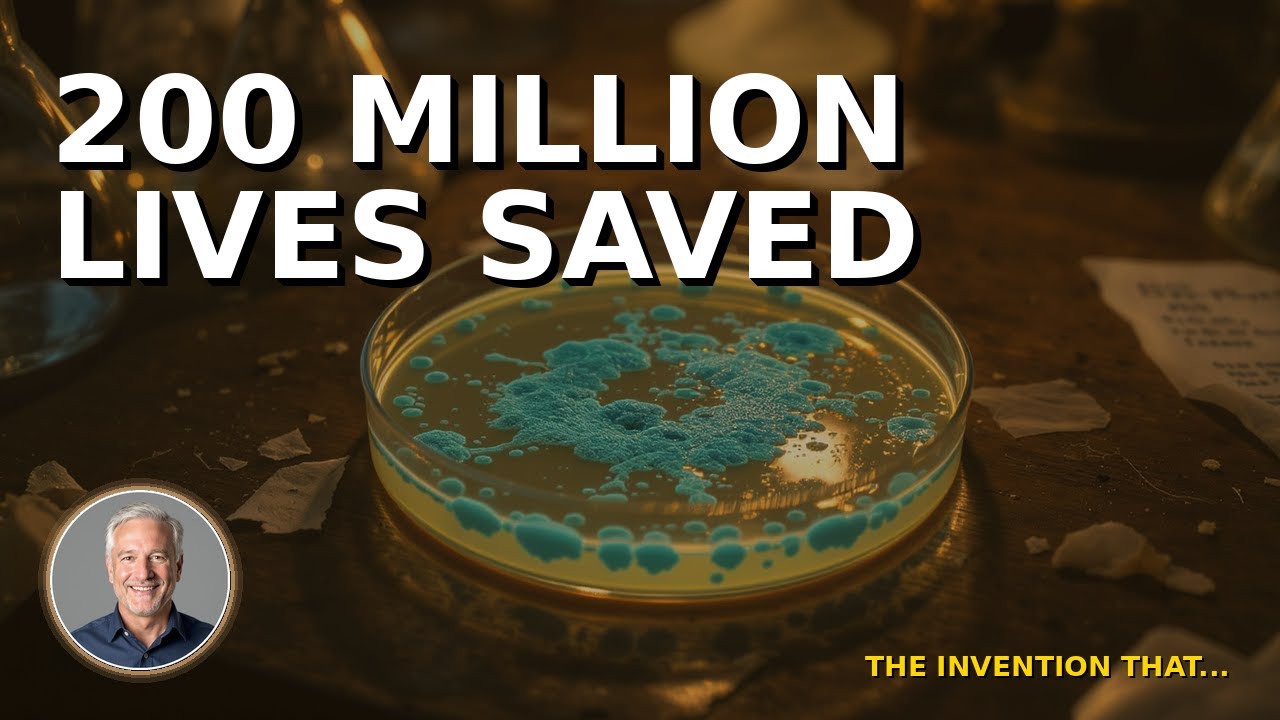
How a Forgotten Petri Dish Changed the Course of Human History: The Penicillin Revolution That Saved 200 Million Lives
In September 1928, Alexander Fleming returned to his cluttered laboratory at St. Mary’s Hospital in London after a two-week vacation to find something that would fundamentally alter the trajectory of human civilization. A contaminated bacterial culture, left carelessly on his workbench, contained a peculiar mold that had killed the surrounding bacteria. That moment of serendipity—born from sloppy laboratory practices and an open window—would eventually save more lives than any single medical discovery in history.
The World Before Antibiotics: When Minor Cuts Meant Death
To understand the magnitude of Fleming’s discovery, we must first grasp the deadly reality of pre-antibiotic medicine. In 1900, infectious diseases were the leading cause of death worldwide. Pneumonia, tuberculosis, and simple wound infections killed with ruthless efficiency. A rose thorn prick could trigger fatal blood poisoning. Childbirth carried enormous risks due to puerperal sepsis. Surgery remained primitive and dangerous, limited not by surgical skill but by the near-certainty of post-operative infection.
The numbers tell a stark story: in the early 20th century, bacterial pneumonia killed 30% of those it infected. Scarlet fever, meningitis, and septicemia claimed countless lives, particularly among children. Military medicine was especially brutal—more soldiers died from infected wounds than from the wounds themselves during World War I.
Fleming’s Messy Discovery: September 1928
Alexander Fleming was not known for his meticulous laboratory habits. Colleagues often remarked on his tendency to leave culture plates scattered around his workspace for weeks. On September 3, 1928, this apparent carelessness became scientific serendipity.
Fleming had been studying Staphylococcus bacteria when he left for vacation, leaving several culture plates exposed on his laboratory bench. London’s unusually cool August weather, combined with an open window, created perfect conditions for contamination. When Fleming returned, he noticed that one plate showed something extraordinary: a blue-green mold had grown in one corner, and around it, the bacterial colonies had dissolved.
Rather than simply discarding the contaminated plate—as most researchers would have done—Fleming’s trained eye recognized something significant. The mold, later identified as Penicillium notatum, was producing a substance that killed bacteria without harming human tissue.
Fleming named this mysterious substance “penicillin” and conducted preliminary experiments that confirmed its remarkable properties. He published his findings in the British Journal of Experimental Pathology in 1929, but the paper generated little interest. Fleming himself couldn’t stabilize the compound or produce it in meaningful quantities, and he eventually moved on to other research.
The Oxford Resurrection: Florey and Chain Transform Discovery into Medicine
For over a decade, penicillin remained a laboratory curiosity. Then, in 1938, Howard Florey, an Australian pathologist at Oxford University, encountered Fleming’s forgotten research. Florey assembled a team that included Ernst Boris Chain, a German-Jewish biochemist who had fled Nazi persecution.
Chain’s expertise in biochemistry proved crucial. By 1940, he had developed methods to purify and concentrate penicillin, making it stable enough for medical testing. The Oxford team’s first animal experiments were dramatic: mice injected with lethal doses of streptococci survived when treated with penicillin, while untreated control animals died within hours.
The first human trials began in February 1941 with Police Constable Albert Alexander, who had developed a severe infection after scratching his eye on a rose thorn. Initial treatment showed remarkable improvement, but the Oxford team’s limited supply ran out. Alexander’s infection returned with fatal consequences, highlighting the desperate need for large-scale production.
Despite this setback, subsequent trials with sufficient penicillin doses achieved unprecedented success rates. By mid-1941, Florey had compelling evidence that penicillin could revolutionize medicine—if only they could produce enough.
The American Production Miracle: Peoria’s Unlikely Role
With Britain consumed by World War II, Florey and his colleague Norman Heatley traveled to the United States in July 1941 to secure industrial production. They arrived at the Northern Regional Research Laboratory in Peoria, Illinois, carrying precious spores of Penicillium notatum literally in their coat pockets.
The Peoria facility, originally established to find commercial uses for agricultural waste, became the unlikely epicenter of the penicillin revolution. Researchers discovered that corn steep liquor—a waste product from corn processing—provided an ideal growth medium for penicillin production.
But the breakthrough moment belonged to Mary Hunt, a laboratory assistant whose job involved collecting mold samples from local sources. In 1943, Hunt brought in a moldy cantaloupe from a Peoria grocery store. The mold, Penicillium chrysogenum, produced 200 times more penicillin than Fleming’s original strain. This “golden mold” became the foundation for mass production.
American pharmaceutical companies, supported by government contracts, rapidly scaled up production using deep fermentation techniques borrowed from brewery operations. By 1943, U.S. facilities were producing enough penicillin to treat every Allied soldier wounded on D-Day.
Wartime Impact and Post-War Revolution
Penicillin’s impact on World War II was immediate and dramatic. Battle casualty mortality rates plummeted as previously fatal wound infections became treatable. The drug proved equally effective against gonorrhea, syphilis, and other bacterial diseases that had long plagued military forces.
But the true revolution came in the post-war era. Civilian access to penicillin transformed everyday medical practice. Childhood diseases like scarlet fever and rheumatic fever became manageable rather than deadly. Surgical procedures expanded dramatically as post-operative infection rates declined. Pneumonia, once called “the old man’s friend” for its role in ending prolonged suffering, became a treatable condition rather than a death sentence.
Statistical evidence of penicillin’s impact is staggering. Deaths from bacterial infections dropped by over 80% in developed countries between 1940 and 1960. Life expectancy increased by approximately eight years, with penicillin and subsequent antibiotics contributing an estimated 4-6 years of that gain.
The Broader Antibiotic Era: Building on Fleming’s Foundation
Fleming’s accidental discovery launched the entire antibiotic era. Researchers, inspired by penicillin’s success, began systematic searches for other antimicrobial compounds. Streptomycin, discovered in 1943, provided the first effective treatment for tuberculosis. Chloramphenicol, tetracycline, and dozens of other antibiotics followed, each expanding medicine’s arsenal against bacterial disease.
By 1970, many medical professionals believed bacterial infections had been conquered. This optimism would prove premature as antibiotic resistance emerged, but the fundamental transformation was undeniable: humanity had gained its first truly effective weapons against bacterial pathogens.
Modern Relevance: Lessons from Laboratory Serendipity
Fleming’s story offers profound insights into the nature of scientific discovery and medical progress. First, it demonstrates how transformative breakthroughs often emerge from unexpected circumstances rather than directed research. Fleming wasn’t seeking antibiotics—he was studying bacterial variation when contamination revealed something revolutionary.
Second, the penicillin story illustrates the crucial difference between discovery and application. Fleming’s identification of penicillin was brilliant, but it took Florey and Chain’s systematic development work, combined with American industrial capacity, to transform laboratory curiosity into life-saving medicine.
Perhaps most importantly, the penicillin revolution reminds us that medical miracles often result from sustained collaboration across disciplines and nations. Fleming’s biological insight, Chain’s biochemical expertise, American industrial capabilities, and Mary Hunt’s moldy cantaloupe all played essential roles in saving those 200 million lives.
Today, as we face new challenges from antibiotic-resistant bacteria and emerging infectious diseases, Fleming’s accidental discovery serves as both inspiration and warning. It reminds us that scientific breakthroughs can emerge from the most unlikely circumstances, but also that maintaining our medical arsenal against bacterial threats requires continued vigilance, research, and international cooperation.
The next time you take an antibiotic for a simple infection, remember that your survival may depend on a scientist who forgot to clean his laboratory bench before going on vacation in 1928. In the grand sweep of medical history, few accidents have proven so fortunate for humanity.