The Rise and Fall of Service Merchandise: How America’s Catalog Showroom King Lost Its Crown
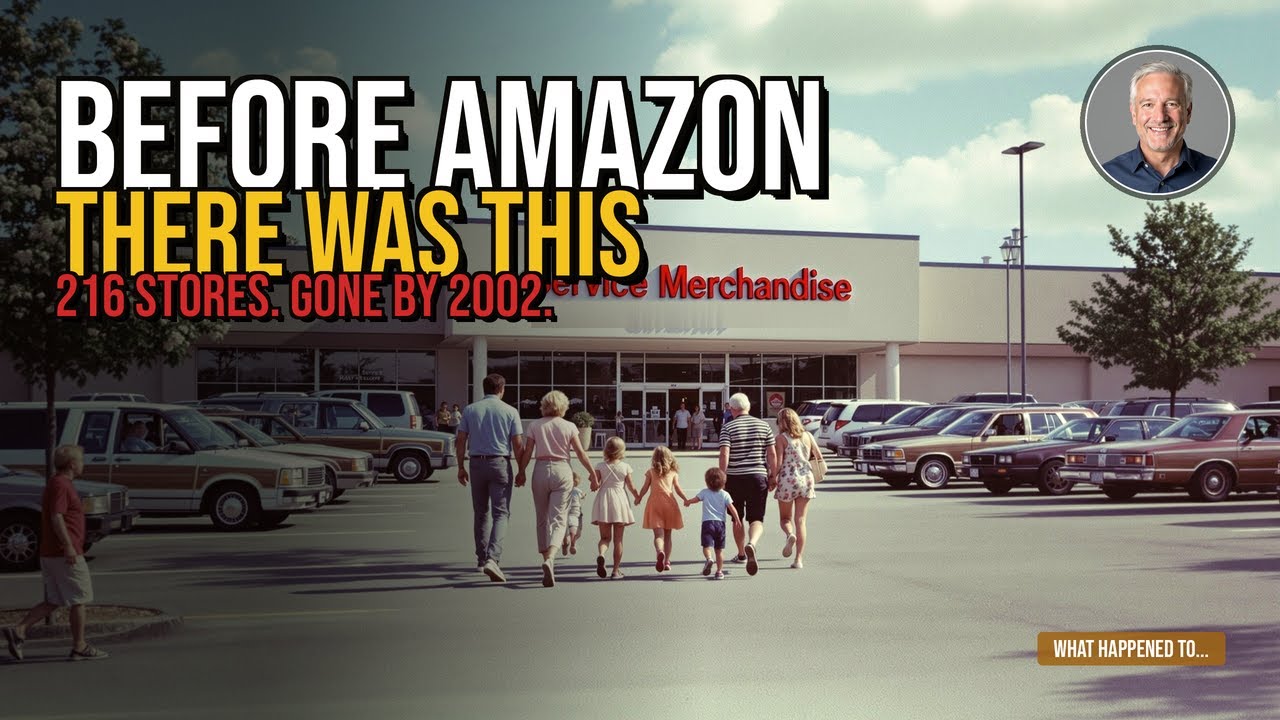
Before Amazon revolutionized retail with same-day delivery and endless digital catalogs, there was Service Merchandise—a Nashville-born retail empire that pioneered the catalog showroom concept and became America’s largest jewelry retailer. From 1934 to 2002, this innovative company transformed how Americans shopped for everything from diamond rings to televisions, only to vanish almost overnight in one of retail history’s most dramatic collapses.
At its peak in the 1980s, Service Merchandise operated over 450 stores across 43 states, generating billions in annual revenue through a unique shopping experience that combined the convenience of catalog browsing with the immediacy of in-store pickup. Yet by 2002, this retail giant had completely disappeared from the American landscape, leaving behind empty storefronts and bewildered customers who wondered: what happened to Service Merchandise?
## The Zimmerman Brothers’ Revolutionary Concept
The Service Merchandise story begins in 1934 Nashville, where brothers Harry, Joseph, and Raymond Zimmerman founded what would become a retail phenomenon. Initially operating as a small jewelry distributor, the company’s breakthrough came in the post-World War II era when the brothers developed their signature catalog showroom format—a hybrid retail model that would define their success for decades.
The concept was deceptively simple yet revolutionary for its time. Customers would browse thick, colorful catalogs filled with merchandise ranging from fine jewelry to electronics and home goods. After selecting items, they would visit a Service Merchandise showroom where sample products were displayed behind glass cases. Shoppers would then place orders with sales associates, who would retrieve the actual merchandise from a vast warehouse connected to each store.
This system offered compelling advantages to both retailer and customer. Service Merchandise could maintain lower overhead costs by requiring minimal floor space for inventory display while maximizing warehouse efficiency. Customers, meanwhile, enjoyed catalog-style convenience combined with the ability to examine products in person before purchasing—a significant benefit in an era before liberal return policies became standard.
## The Golden Age: Dominating America’s Malls
The 1970s and 1980s marked Service Merchandise’s golden age, as the company expanded aggressively across suburban America. The Zimmerman family’s timing proved impeccable, as their catalog showroom concept perfectly aligned with several major demographic and economic trends reshaping American retail.
The post-war suburban boom created ideal conditions for Service Merchandise’s expansion strategy. Shopping malls proliferated across American suburbs, and Service Merchandise secured prime anchor tenant positions alongside traditional department stores. Their distinctive warehouse-style buildings, typically featuring large glass facades and prominent signage, became familiar landmarks in shopping centers from coast to coast.
By 1982, Service Merchandise had achieved remarkable penetration in the American retail market, operating 302 stores and generating over $2 billion in annual sales. The company’s jewelry division proved particularly lucrative, eventually capturing enough market share to claim the title of America’s largest jewelry retailer—a position that underscored the effectiveness of their showroom model for high-value merchandise.
The catalog showroom format offered unique advantages for jewelry sales. Customers could examine expensive items in secure, well-lit display cases without the intimidation factor often associated with traditional jewelry stores. The warehouse pickup system also provided an additional layer of security for valuable merchandise while keeping prices competitive through operational efficiency.
## Innovation and Operational Excellence
Service Merchandise’s success stemmed from more than just their novel retail format; the company invested heavily in operational systems that maximized efficiency and customer satisfaction. Their integrated catalog-to-warehouse operations required sophisticated inventory management and logistics coordination that was ahead of its time.
Each Service Merchandise location functioned as a complex logistical operation. The company’s catalogs, produced twice yearly and distributed to millions of households, had to accurately reflect inventory availability across hundreds of locations. Meanwhile, the warehouse systems needed to rapidly process customer orders while maintaining accurate stock levels for both showroom displays and actual merchandise.
The pickup process itself became a signature element of the Service Merchandise experience. After placing orders, customers would wait in designated seating areas until their merchandise arrived via conveyor belt or cart from the attached warehouse. This “theater of retail” created a sense of anticipation and satisfaction that many customers found engaging, particularly children who enjoyed watching for their family’s purchases to emerge from the mysterious back warehouse.
Technology adoption proved crucial to Service Merchandise’s operational success. The company invested early in computerized inventory systems and barcode scanning, enabling real-time coordination between catalog offerings, showroom displays, and warehouse stock. These systems provided competitive advantages in an era when many retailers still relied on manual inventory tracking.
## The Beginning of the End: Changing Retail Landscape
Despite its apparent success, Service Merchandise began facing mounting challenges in the 1990s as the American retail landscape underwent fundamental transformation. Several concurrent trends converged to undermine the catalog showroom model that had powered the company’s growth for decades.
The rise of big-box retailers like Walmart and Target introduced new competitive pressures that Service Merchandise struggled to address. These chains offered similar merchandise at competitive prices while providing immediate gratification—customers could browse products, make purchase decisions, and leave with their items immediately rather than waiting for warehouse retrieval.
Simultaneously, traditional department stores began adopting more aggressive pricing strategies and expanding their merchandise selections to compete more directly with catalog showrooms. The pricing advantages that had once made Service Merchandise attractive gradually eroded as larger retailers leveraged superior buying power and operational scale.
Consumer shopping preferences also shifted in ways that disadvantaged Service Merchandise’s format. The delayed gratification inherent in their warehouse pickup system became less appealing as Americans grew accustomed to instant access to merchandise. The rise of credit cards and easier return policies at other retailers eliminated many of the practical advantages that had originally made catalog showrooms attractive.
## Technology Disruption and Strategic Missteps
The emergence of e-commerce in the mid-1990s presented both opportunity and threat for Service Merchandise. As a company built on catalog-based shopping, they seemed well-positioned to transition to online retail. However, the company’s response to digital transformation proved inadequate and poorly timed.
Service Merchandise’s online initiatives lagged behind more aggressive competitors who recognized the internet’s potential earlier. While companies like Amazon were building sophisticated e-commerce platforms and logistics networks, Service Merchandise remained focused on their traditional catalog showroom model. Their belated entry into online retail lacked the investment and strategic focus necessary to compete effectively in the rapidly evolving digital marketplace.
The company also struggled with inventory management and cost control as sales declined. The catalog showroom model required significant fixed costs for warehouse operations and catalog production, creating financial pressure when revenue dropped. Service Merchandise found itself caught in a vicious cycle: declining sales led to reduced catalog circulation and store closures, which further reduced sales and market visibility.
Strategic decisions during this period reflected the challenges of adapting a successful business model to changing market conditions. Service Merchandise experimented with various format changes, including smaller stores and modified merchandise mixes, but these efforts failed to address the fundamental obsolescence of their catalog showroom concept.
## The Final Chapter: Liquidation and Legacy
Service Merchandise’s decline accelerated dramatically in the late 1990s and early 2000s. Financial pressures mounted as the company struggled with debt obligations while facing continued revenue erosion. In 2002, after 68 years in business, Service Merchandise filed for bankruptcy and announced the closure of all remaining stores.
The liquidation process proved swift and final. Unlike some retail bankruptcies that result in partial reorganization or acquisition by competitors, Service Merchandise disappeared entirely from the American retail landscape. The company’s real estate portfolio was sold to various buyers, with many former Service Merchandise locations eventually becoming other retail chains or remaining vacant.
For many Americans, particularly those who had grown up visiting Service Merchandise during the 1970s and 1980s, the company’s disappearance marked the end of a distinctive shopping experience. The ritual of browsing catalogs, visiting showrooms, and waiting for merchandise to arrive from the warehouse had become a nostalgic memory of pre-internet retail.
## Lessons for Modern Retail: What Service Merchandise Teaches Us
The Service Merchandise story offers valuable insights into retail evolution and the challenges facing companies built around specific technological or operational advantages. Their rise and fall demonstrates how innovative business models can create tremendous value while remaining vulnerable to fundamental shifts in consumer behavior and competitive dynamics.
Perhaps most significantly, Service Merchandise’s experience foreshadowed many aspects of modern e-commerce. Their catalog-based shopping, centralized inventory management, and fulfillment operations shared conceptual similarities with today’s online retail giants. However, the company’s physical limitations and failure to adapt quickly enough to digital transformation ultimately proved fatal.
The parallels between Service Merchandise’s catalog showrooms and contemporary “buy online, pick up in store” options are particularly striking. Modern retailers have essentially recreated aspects of the Service Merchandise experience while eliminating the delays and limitations that made the original model obsolete. Companies like Best Buy and Target now offer the convenience of online ordering combined with immediate pickup options that mirror Service Merchandise’s original value proposition.
Service Merchandise’s story also illustrates the importance of continuous innovation and adaptation in retail. Their catalog showroom concept represented genuine innovation that created significant competitive advantages for several decades. However, the company’s inability to evolve beyond this model when market conditions changed demonstrates how yesterday’s innovations can become tomorrow’s liabilities without constant reinvention.
Today, as artificial intelligence, augmented reality, and new logistics technologies reshape retail once again, the Service Merchandise experience serves as both inspiration and warning. Their success in creating a unique, efficient retail format shows the rewards available to genuine innovators. Their ultimate failure reminds us that no business model, however successful, can survive indefinitely without adaptation to changing times.